Watchmaking
Breguet's tourbillon (1801) and gravity in a pocket watch
Gravity always pulls the same way. In a pocket watch carried upright, it upsets the timekeeping, day after day. In 1801, Abraham-Louis Breguet found an answer: keep the entire regulating organ turning on itself. Two centuries later, tourbillons are still made, mostly for luxury watches.
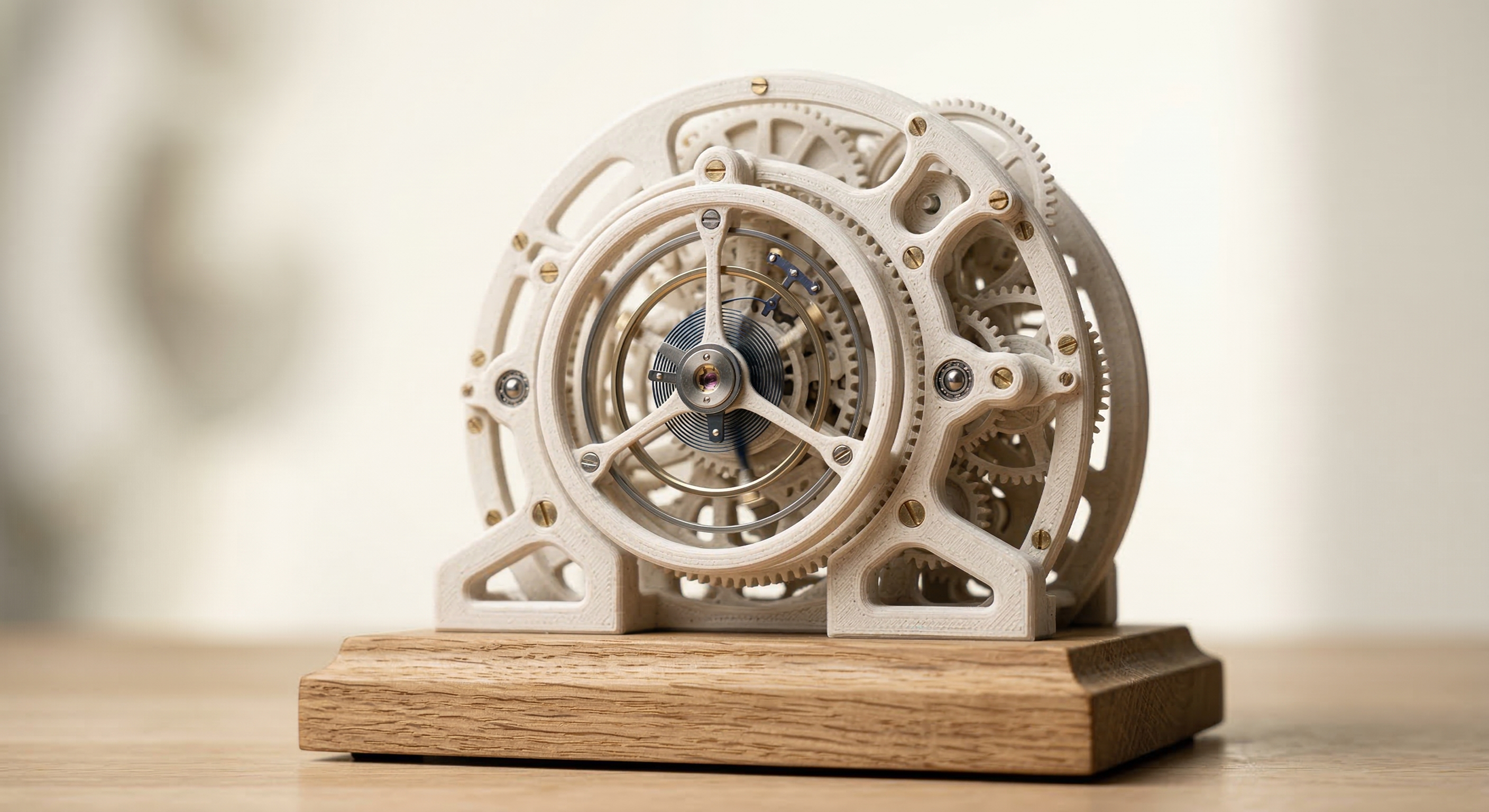
The problem: a watch that lives upright
The heart of a mechanical watch is the balance: a small wheel that swings back and forth, returned by a hairspring, several times a second. To beat at a perfectly steady rate, it would have to be perfectly poised, its mass spread exactly around its axis. In practice, a tiny imbalance always remains.
Lying flat, that imbalance hardly matters: gravity pulls at right angles to the balance axis and favours no side. But a pocket watch spends its day upright, crown up, in a waistcoat pocket. Gravity then always pulls on the same spot of the balance, speeding up part of the swing and slowing another. The result: a rate error that changes with the watch's position, and adds up.
1801: Breguet's idea
Abraham-Louis Breguet, born in 1747 in Neuchâtel, Switzerland, was already the most inventive watchmaker of his age. He had refined the self-winding watch, created a hairspring with an overcoil that still bears his name, and protected pivots against shocks. On 26 June 1801, 7 Messidor Year IX of the Republican calendar, he obtained a ten-year patent for a new regulator: the tourbillon.
His reasoning was relentlessly logical. The imbalance cannot be removed. But if the whole assembly, balance, hairspring, lever and escape wheel, is made to turn slowly and continuously on itself, the imbalance passes in turn through top, bottom, left and right. The error that makes the watch gain in one position makes it lose in the opposite one. Over a full turn, the errors cancel out.
The mechanics: a cage turning around a fixed wheel
The feat is mechanical. Breguet housed the entire regulating organ in a light cage mounted on pivots. The cage is driven by the watch's gear train, like an ordinary wheel. At the centre, a toothed wheel stays fixed to the mainplate. The escape wheel pinion, carried round by the cage, rolls on that fixed wheel, like a satellite around a planet.
That rolling turns the escape wheel, which makes the lever and the balance beat, and they keep working throughout the journey. On most tourbillons, the cage turns once a minute. A hand is often fitted to it: it then serves as the seconds hand, and time is read on the mechanism itself.
The price is high. The cage must be as light as possible, because every gram costs energy on every turn. The parts are tiny and the adjustments delicate. In his lifetime, Breguet sold only a few dozen tourbillon watches.
After Breguet: variations and trials
The nineteenth and twentieth centuries brought many variations. In 1892, the Danish watchmaker Bahne Bonniksen, working in England, patented the karrusel, a slower rotating carriage that was simpler to make. In 1920, the German Alfred Helwig, a teacher at a watchmaking school, invented the flying tourbillon: the cage is held only from below, with no bridge above, and the mechanism seems to float inside the watch.
For decades, tourbillons shone in observatory chronometry trials, where the world's best watches were tested in every position for weeks. There, their advantage was measurable: a watch tested upright gets the full benefit of the compensation.
On the wrist: a debate, and a symbol
One question still divides watchmakers. On the wrist, a watch changes position constantly: the arm moves, lies flat, rises again. The problem Breguet set out to solve arises far less than at the bottom of a pocket. The timekeeping gain of a wristwatch tourbillon is real but debated.
Its prestige, however, is beyond debate. The first series-produced tourbillon wristwatches arrived in the 1980s, and the tourbillon became the complication that watch houses show off through an opening in the dial. Not only for its precision: for the pleasure of watching a living mechanism turn on itself.
On your desk
In a watch, a tourbillon fits on a fingernail and is viewed through a loupe. Our Giant Watchmaker's Tourbillon enlarges the principle so you can follow it with the naked eye: the cage, the fixed wheel, the escape wheel, the lever and the balance, all in view. One hundred and ninety-five parts, about twenty centimetres tall, rated expert.
It is the centrepiece of a collection, and one of the most demanding builds in the catalogue. Take up the challenge, and you will have on your desk the invention that watchmaking still regards as its masterpiece.
Adrien
Founder and designer of Atlas Kinetics
Adrien draws, prototypes and corrects every mechanism in the catalogue before it goes into production. Here, he shares what he learned by taking them apart.
Meet the workshopThe model: Giant Watchmaker's Tourbillon
195 parts, about 9h to build. The mechanism described above turns between your fingers once the last screw is in.
actual size 14 cm
Watchmaking, Omega series
- Parts
- 195
- Build
- 9 hrs
- Level
- Expert
Read next
All articles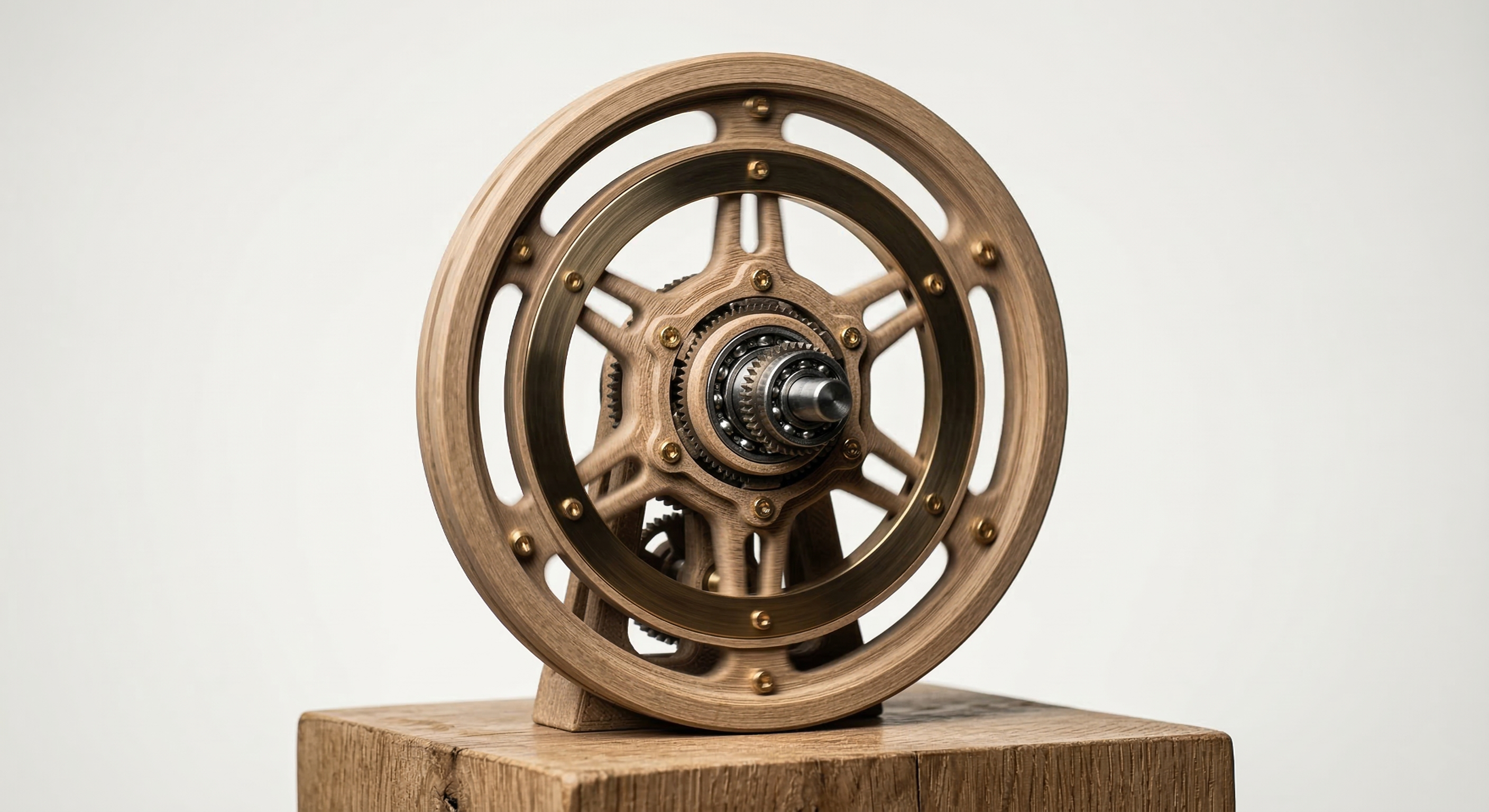
Physics,
Why a spinning gyroscope does not fall over
Spun up to speed, a disc refuses to tip and swings sideways when you push it. From Foucault's experiment to the navigation of aircraft and satellites.
Read the article (4 min)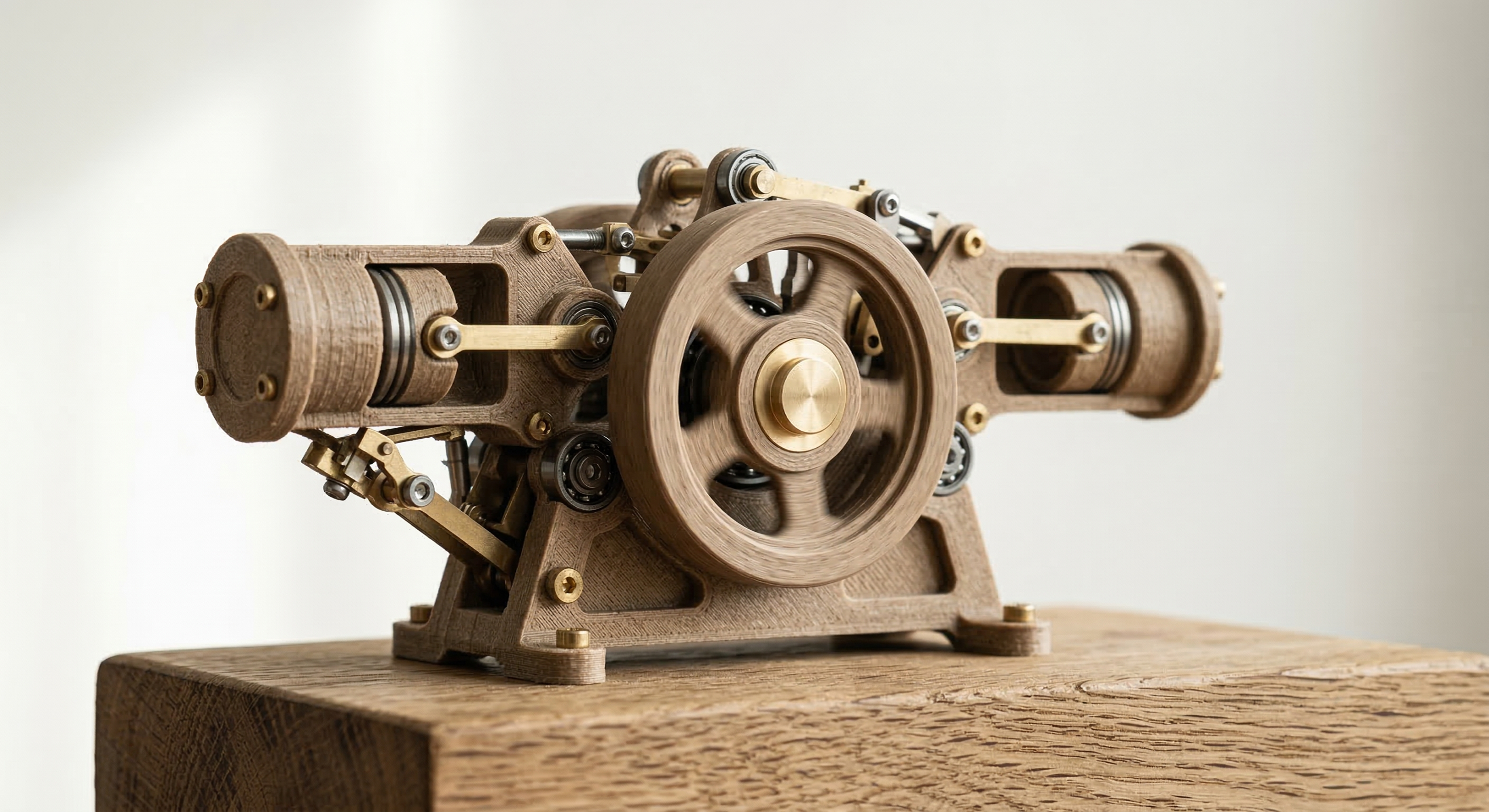
Thermodynamics,
The Stirling engine, a hot-air engine patented in 1816
An engine that cannot explode, burns nothing inside itself and recycles its own heat. Invented in 1816, it now powers submarines and cools sensors.
Read the article (5 min)