Physics
Why a spinning gyroscope does not fall over
Spin a heavy disc up to speed and tilt its frame: it stubbornly keeps its orientation. Push it: it does not tip over, it swings at right angles. This baffling behaviour has guided ships, aircraft and rockets.
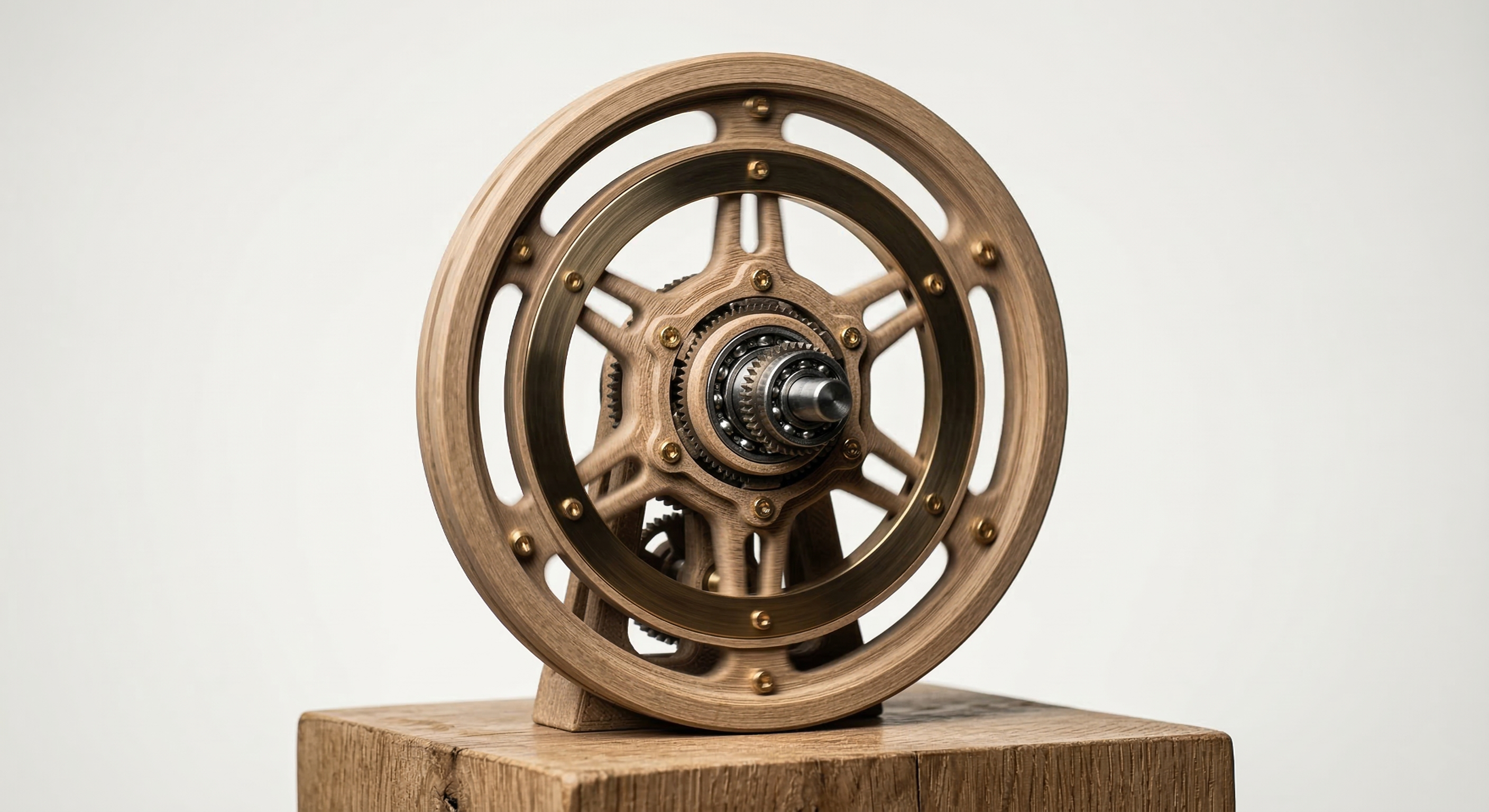
It all starts with a spinning top
A top at rest falls over at once. Spinning, it stands on a tiny point, and when it leans it does not fall: it starts to turn slowly around the vertical, tracing a cone. Children have played with this since antiquity. Physicists took far longer to explain it.
A gyroscope is nothing more than a top freed from gravity and the ground. A heavy disc, an axle, and a mount that lets it point any way it likes. What remains is the pure behaviour of a spinning body.
1852: Foucault gives it a name
As early as 1817, the German astronomer Johann Bohnenberger built a device made of a spinning sphere mounted in pivoting rings. But it was the French physicist Léon Foucault who named it in 1852. A year earlier, his famous pendulum had made the Earth's rotation visible. He was looking for a second, more compact proof.
His idea: a disc spun very fast, mounted so that it can point freely, keeps its direction in space while the Earth turns beneath it. A patient observer should therefore see the disc's axis drift slowly relative to the room. Foucault called the instrument a “gyroscope”, from the Greek gyros, rotation, and skopein, to observe: the device for observing rotation.
The physics: angular momentum
A spinning body has what physicists call angular momentum. Picture it as an arrow along the spin axis, longer the heavier the disc, the further its mass from the centre and the faster it spins. As a formula: angular momentum is the disc's moment of inertia times its spin rate.
To change the direction of that arrow, you need a torque, a twisting effort. And this is where everything becomes counter-intuitive: the arrow does not tip in the direction of the effort, but at right angles to it. That is precession. The larger the angular momentum, the slower the precession: the precession rate equals the torque divided by the angular momentum. A heavy, fast disc therefore resists disturbances almost completely.
That is also why inertia matters so much. At the same speed, a weighted flywheel, with its mass pushed out towards the rim, stores far more angular momentum than a light disc. It holds more firmly, and for longer.
The gimbal: three rings to set it free
For a gyroscope to keep its orientation while its support moves, it must hang in nested rings, each pivoting on an axis at right angles to the previous one. In French this mount bears the name of the Italian scholar Gerolamo Cardano, who described it in the sixteenth century, though far older traces exist. The same principle keeps a ship's compass level as the vessel rolls.
Yet the gimbal hides a trap: when two rings line up, the assembly loses a degree of freedom and can no longer follow certain movements. This is gimbal lock. The inertial platforms of the Apollo missions, mounted on three rings, had to avoid it carefully. During Apollo 11, Michael Collins reportedly joked about asking for a fourth gimbal for Christmas.
From ships to satellites
The twentieth century turned the gyroscope into a navigation instrument. The gyrocompass, developed in Germany by Hermann Anschütz-Kaempfe around 1908 and then in the United States by Elmer Sperry in 1911, points to true north without relying on magnetism, which the steel hulls of ships distort. In aircraft, the artificial horizon and the directional gyro make it possible to fly without seeing outside: on 24 September 1929, the American aviator Jimmy Doolittle took off, flew and landed with zero visibility, guided by his instruments alone.
Then came rockets and satellites, whose orientation gyroscopes measure or correct. The Hubble Space Telescope relies on them to point at its targets. And you have one in your pocket: your phone contains a tiny gyroscope. It does not spin, it vibrates, and measures rotation through the same kind of inertial effect. The principle has changed shape, not purpose: knowing where you are pointing.
On your desk
Our High-Inertia Gyroscope brings together the two ingredients of this article: a weighted flywheel running on ball bearings, and a gimbal mount that lets it point freely. Seventy-two parts, about sixteen centimetres tall, rated intermediate.
Build it, spin it, and let your hands discover what the equations describe. No explanation beats that first precession.
Adrien
Founder and designer of Atlas Kinetics
Adrien draws, prototypes and corrects every mechanism in the catalogue before it goes into production. Here, he shares what he learned by taking them apart.
Meet the workshopThe model: High-Inertia Gyroscope
72 parts, about 3h to build. The mechanism described above turns between your fingers once the last screw is in.
actual size 14 cm
High-Inertia Gyroscope
€36.00
Physics, Spectra series
- Parts
- 72
- Build
- 3 hrs
- Level
- Intermediate
Read next
All articles
Thermodynamics,
The Stirling engine, a hot-air engine patented in 1816
An engine that cannot explode, burns nothing inside itself and recycles its own heat. Invented in 1816, it now powers submarines and cools sensors.
Read the article (5 min)
Topology & Kinetics,
The Möbius strip, a strip of paper with only one side
A strip, a half twist, and the paper loses one of its sides. How an 1858 curiosity became the emblem of topology and of recycling.
Read the article (5 min)