Thermodynamics
The Stirling engine, a hot-air engine patented in 1816
In 1816, a young Scottish minister patented a hot-air engine. No boiler, no explosion, and the same enclosed air working endlessly. Two centuries later, his cycle still turns wherever silence and efficiency matter.
1816: a minister against boilers
In the early nineteenth century, the steam engine was driving the factories, but it had a terrible flaw: its boilers exploded. Plates gave way under pressure, and accidents were frequent and deadly.
Robert Stirling, a young minister of the Church of Scotland, patented a very different machine in 1816. It boiled no water. It heated air, sealed inside the engine once and for all, and made it work by heating and cooling it in turn. The pressure stayed modest; there was nothing to blow up. With his brother James, an engineer, he would refine the machine for decades.
The cycle: four phases, one sealed gas
A petrol engine draws in air, burns fuel in it, then exhausts the gases. The Stirling engine does none of that. Its gas never leaves: the same quantity of air, or helium in modern versions, works indefinitely. The heat comes from outside, through a wall: a flame, the sun, any hot source. One side of the engine is heated, the other is cooled.
The ideal cycle runs through four phases:
- heating: the gas moves to the hot side without changing volume, and its pressure rises;
- expansion: the hot gas expands and pushes the power piston, this is the power stroke;
- cooling: the gas moves to the cold side, and its pressure drops;
- compression: the cold gas is easy to compress, which costs less effort than the expansion delivered.
The difference between the effort gained hot and the effort spent cold is the useful work. The bigger the temperature gap, the more powerful the engine.
The displacer and the power piston
How do you move the gas from hot to cold and back, hundreds of times a minute? With a second piston, the displacer. It compresses nothing: it is narrower than its cylinder and simply shuttles the air from one end to the other. When it goes down, the air moves up to the hot side; when it goes up, the air moves back down to the cold side.
The power piston collects the effort. Both are linked to the same crankshaft, a quarter turn apart: the displacer prepares the gas, and the power piston exploits it a moment later. That 90-degree offset is the heart of the design. Without it, the cycle does not run.
Engineers developed the principle into three families. The alpha version uses two power pistons in two cylinders, one hot and one cold. The beta version houses the displacer and the piston in the same cylinder. The gamma version separates them into two connected cylinders. All of them follow the same cycle.
The regenerator, the real invention
The 1816 patent does not just protect an engine. Above all, it describes what Stirling called an “economiser”, known today as the regenerator: a mass of fine wires or mesh placed in the gas path, between the hot side and the cold side.
When the hot gas heads to the cold side, it passes through this mass and leaves its heat there. When it comes back, it picks the heat up again on the way. Instead of being lost on every cycle, the heat shuttles back and forth inside the engine. On paper, a Stirling cycle with a perfect regenerator reaches the maximum efficiency physics allows between two temperatures, the Carnot efficiency. No real engine gets there, but the idea was brilliant as early as 1816.
Why it lost the race
Thousands of small hot-air engines pumped water and drove fans in the nineteenth century. But to move a car, the Stirling has real handicaps. It is slow to start, while the hot side warms up. It is poor at changing speed: you cannot adjust an external flame as quickly as a petrol injection. And for its power, it remains heavy.
So the internal combustion engine won. The Stirling did not disappear, though: the Dutch group Philips revived it in the 1930s to generate electricity and kept developing it for several decades.
Today: wherever silence matters
Its flaws on the road become strengths elsewhere. No explosions in the cylinders, so very little noise and vibration: since the 1990s, Swedish submarines of the Gotland class have cruised submerged on Stirling engines without having to surface to breathe. Any heat will do: solar plants focus sunlight on the hot head of a Stirling.
And the cycle is reversible. Drive a real, sealed Stirling engine with another motor and it pumps heat: one side gets cold, the other warms up. Stirling cryocoolers chill infrared sensors to very low temperatures this way. NASA even developed a Stirling generator for its space probes, before cancelling the programme in 2013.
On your desk
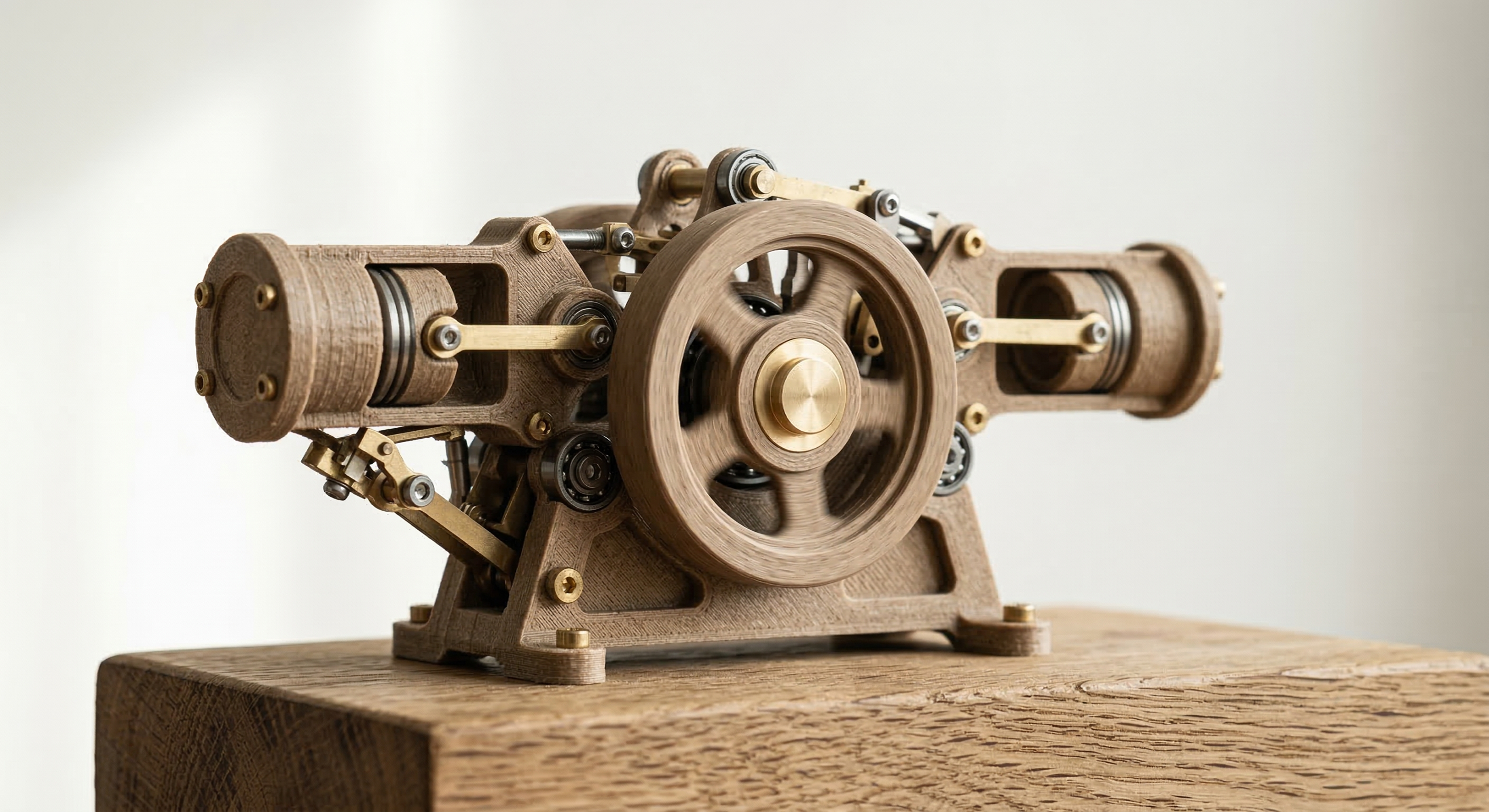
Our Stirling Engine Demonstrator is a teaching model: you do not heat it, you turn it by hand to see what each part does. Flywheel, crankshaft, displacer and power piston, with the real engine's quarter-turn offset. One hundred and ten parts, sixteen centimetres long, rated advanced.
It is the model to build when you finally want to understand the cycle you met in physics class, and watch it turn before your eyes.
Adrien
Founder and designer of Atlas Kinetics
Adrien draws, prototypes and corrects every mechanism in the catalogue before it goes into production. Here, he shares what he learned by taking them apart.
Meet the workshopThe model: Stirling Engine Demonstrator
110 parts, about 4h30 to build. The mechanism described above turns between your fingers once the last screw is in.
actual size 16 cm
Thermodynamics, Spectra series
- Parts
- 110
- Build
- 4 hrs 30 min
- Level
- Advanced
Read next
All articles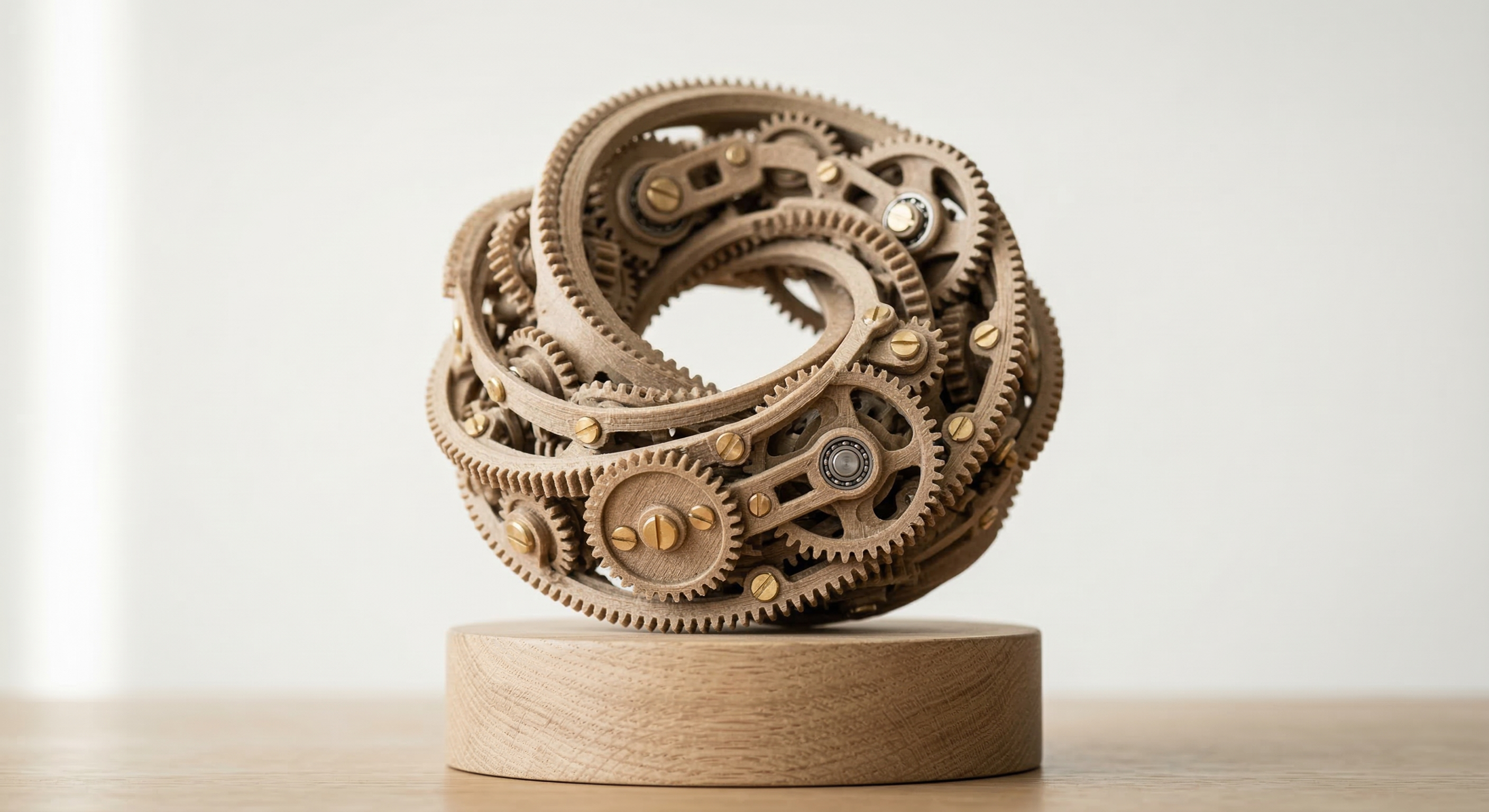
Topology & Kinetics,
The Möbius strip, a strip of paper with only one side
A strip, a half twist, and the paper loses one of its sides. How an 1858 curiosity became the emblem of topology and of recycling.
Read the article (5 min)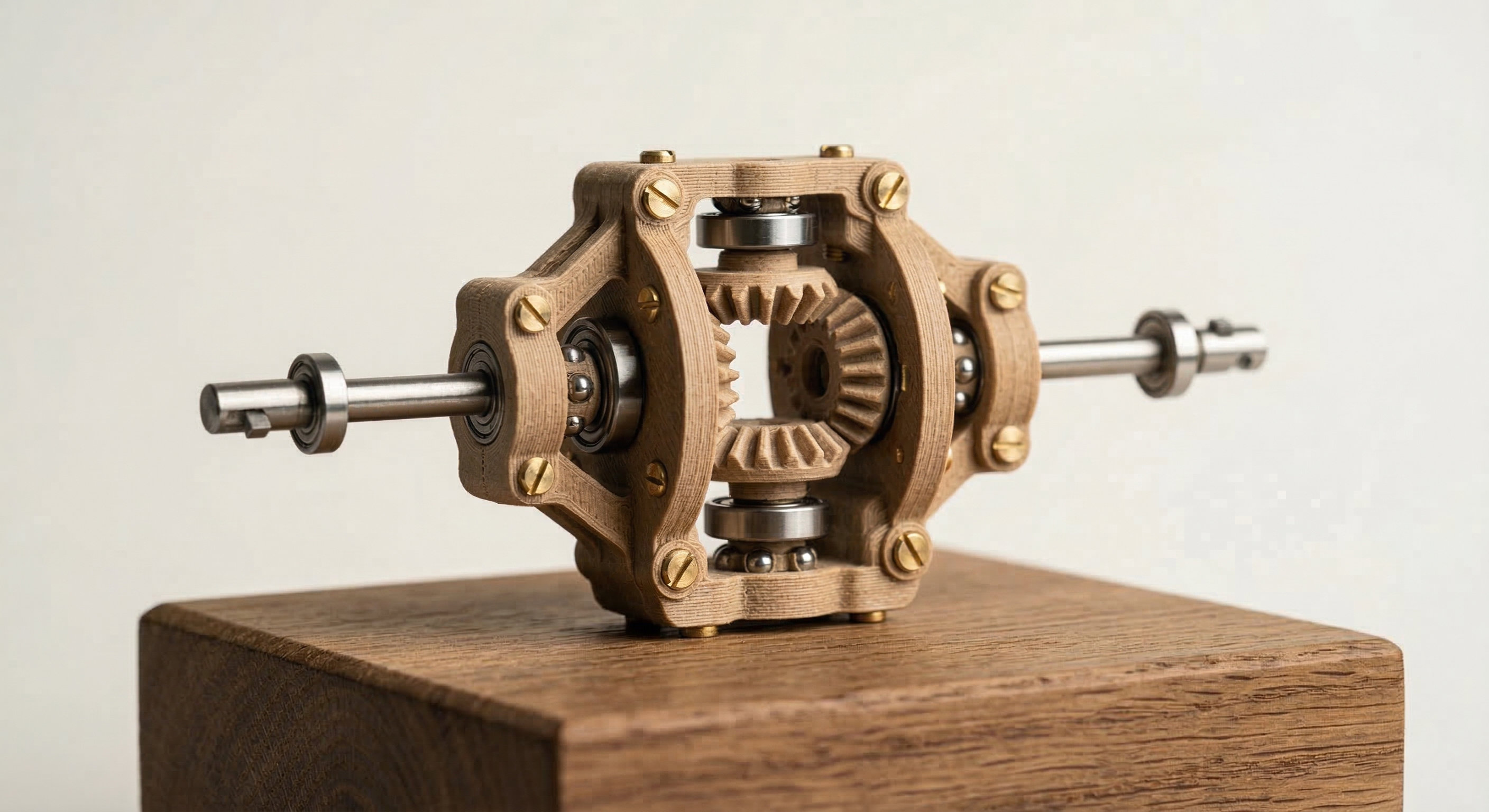
Power transmission,
The differential, or why two wheels on one axle turn at different speeds
In a corner, your two wheels do not travel the same distance. The differential has solved that puzzle since 1827. Open the case and follow the torque.
Read the article (4 min)