Topology & Kinetics
The Möbius strip, a strip of paper with only one side
Take a strip of paper, flip one end, tape it shut. You have just made an object with only one side and one edge, one that has fed an entire branch of mathematics. It even turns up today in the recycling logo.

One minute, one strip of paper
The best thing about the Möbius strip is that you can make one before you even read its story. Cut a long, narrow strip of paper. Bring the two ends together as if to make a ring, but before joining them, flip one of them over by half a turn. A piece of tape, and you are done.
Now take a pencil and draw a line along the middle of the strip without lifting the lead. You will come back to your starting point after going round twice, and the line will cover both "sides" of the strip. There is in fact only one. Run your finger along the edge: a single edge too, a single closed loop.
Two discoverers, the same year
The object bears the name of August Ferdinand Möbius, a German astronomer and mathematician who taught in Leipzig. In 1858, while working on the geometry of polyhedra, he came across this strange surface. That same year, unaware of him, another German, Johann Benedict Listing, made the same discovery in Göttingen.
Listing published first, in 1861; Möbius only described his strip in 1865. Yet it is his name that stuck. Listing has a sizeable consolation: as early as 1847, he coined the word "topology". This branch of mathematics studies shapes without caring about distances: what stays true when you stretch, twist or bend an object without tearing it.
One side, one edge, and no underneath
For a topologist, what matters is neither the length of the strip nor its colour, but the number of sides and edges. An ordinary ring has two of each: an inside, an outside, a top edge, a bottom edge. The Möbius strip has only one of each. An ant walking along the middle of the strip would cover all of it, top and bottom, without ever crossing an edge. The Dutch graphic artist M. C. Escher drew exactly that walk in 1963, with a procession of red ants.
Mathematicians call the surface non-orientable: there is no consistent way to define a top and a bottom on it, not even a left and a right. A little figure drawn on the strip and slid all the way round would come back to its starting point reversed, as in a mirror.
Glue two Möbius strips together edge to edge and you get an even more baffling object, impossible to build in our space without it passing through itself: the Klein bottle, described by Felix Klein in 1882.
The scissors experiment
The Möbius strip saves its best surprises for anyone who picks up scissors. Cut an ordinary ring along its centre line and, unsurprisingly, you get two rings. Do the same with a Möbius strip and you get a single band, twice as long, which this time has two sides, two edges and two full twists.
Start again, cutting a third of the way across instead of down the middle. You will go round twice before returning to your starting point, and you will end up with two interlinked rings: a narrower Möbius strip, the same length as the original, and a band twice as long, caught in the first like a link in a chain.
These experiments take five minutes with a sheet of paper and a roll of tape. They are worth every proof: topology is first of all a matter of hands.
From conveyor belts to the recycling logo
A surface with no reverse side has very practical advantages. A conveyor belt fitted with a half twist wears over its whole surface instead of a single face, so it lasts longer. In the 20th century, several patents took up the idea for belts, typewriter ribbons and loops of magnetic tape.
The strip also conquered the imagination. In 1970, an American student, Gary Anderson, won a design competition with three arrows folded into a loop: the universal recycling logo is a Möbius strip. Artists, architects and sculptors keep coming back to it, fascinated by a shape that seems to close on itself without ever ending.
From paper to gears
Making a Möbius strip out of paper is child's play. Making one that turns on itself is another story. The half twist that closes the loop imposes a constraint: each segment has to pivot slightly relative to its neighbour, and the whole thing has to keep turning without jamming anywhere.
On our model, that twist is spread along the whole length. Toothed rings and articulated links mesh on axles running in bearings, and each joint takes up a small share of the half twist. None of them is forced, and the loop runs on endlessly.
On your desk
Our Articulated Möbius Knot fits in your hand: 14 × 14 × 6 cm, thirty-six parts, a beginner-rated build of about an hour. No delicate adjustment: you assemble the loop, set it going, and it turns. It is an ideal first kit, and one of the most captivating to watch.
Put it on your desk and wait for your visitors to ask: "But where is the underneath?" You will have the answer, and a strip of paper to prove it.
Adrien
Founder and designer of Atlas Kinetics
Adrien draws, prototypes and corrects every mechanism in the catalogue before it goes into production. Here, he shares what he learned by taking them apart.
Meet the workshopThe model: Articulated Möbius Knot
36 parts, about 1h to build. The mechanism described above turns between your fingers once the last screw is in.
actual size 14 cm
Articulated Möbius Knot
€27.00
Topology & Kinetics, Alpha series
- Parts
- 36
- Build
- 1 hr
- Level
- Beginner
Read next
All articles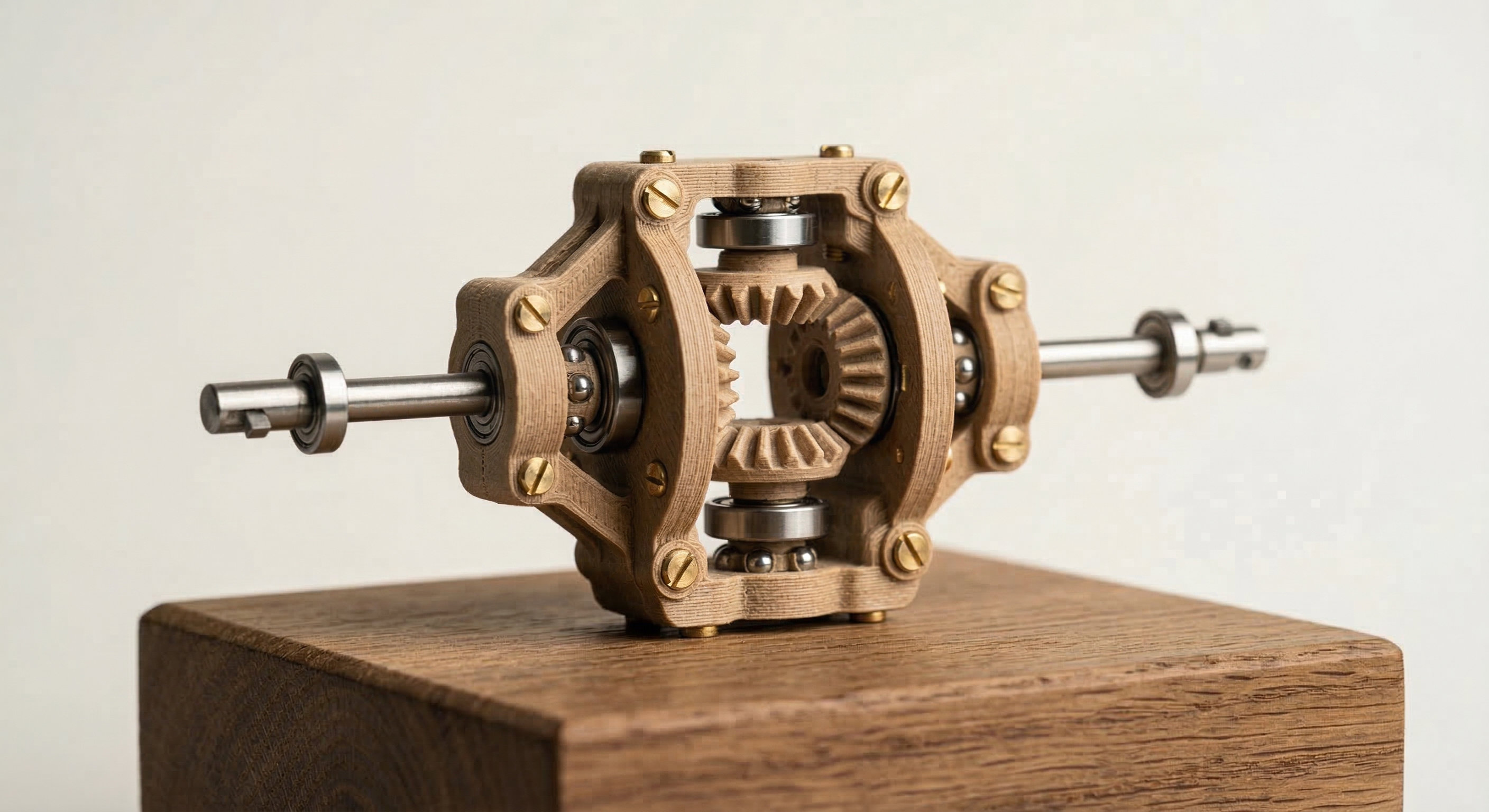
Power transmission,
The differential, or why two wheels on one axle turn at different speeds
In a corner, your two wheels do not travel the same distance. The differential has solved that puzzle since 1827. Open the case and follow the torque.
Read the article (4 min)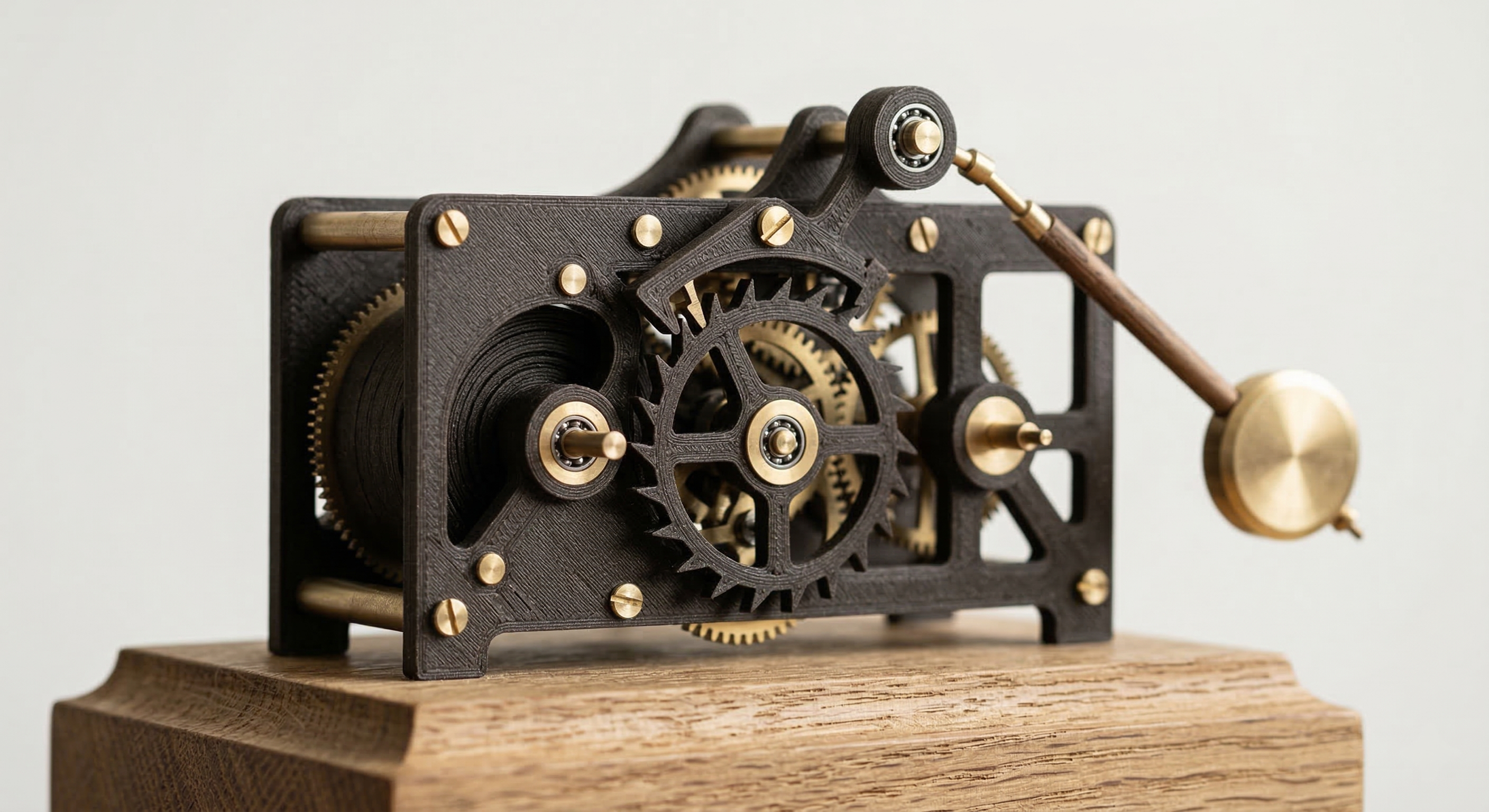
Watchmaking,
The anchor escapement, the part that regulates a pendulum clock
A falling weight does not tell the time. It must be held back and released, tooth by tooth. The history and workings of the anchor escapement.
Read the article (5 min)