Power transmission
The differential, or why two wheels on one axle turn at different speeds
Take a corner in a car: the outer wheel covers more ground than the inner one. If a rigid axle tied them together, one would have to slip, squeal and wear. A handful of gears has solved this in every car for nearly two centuries.
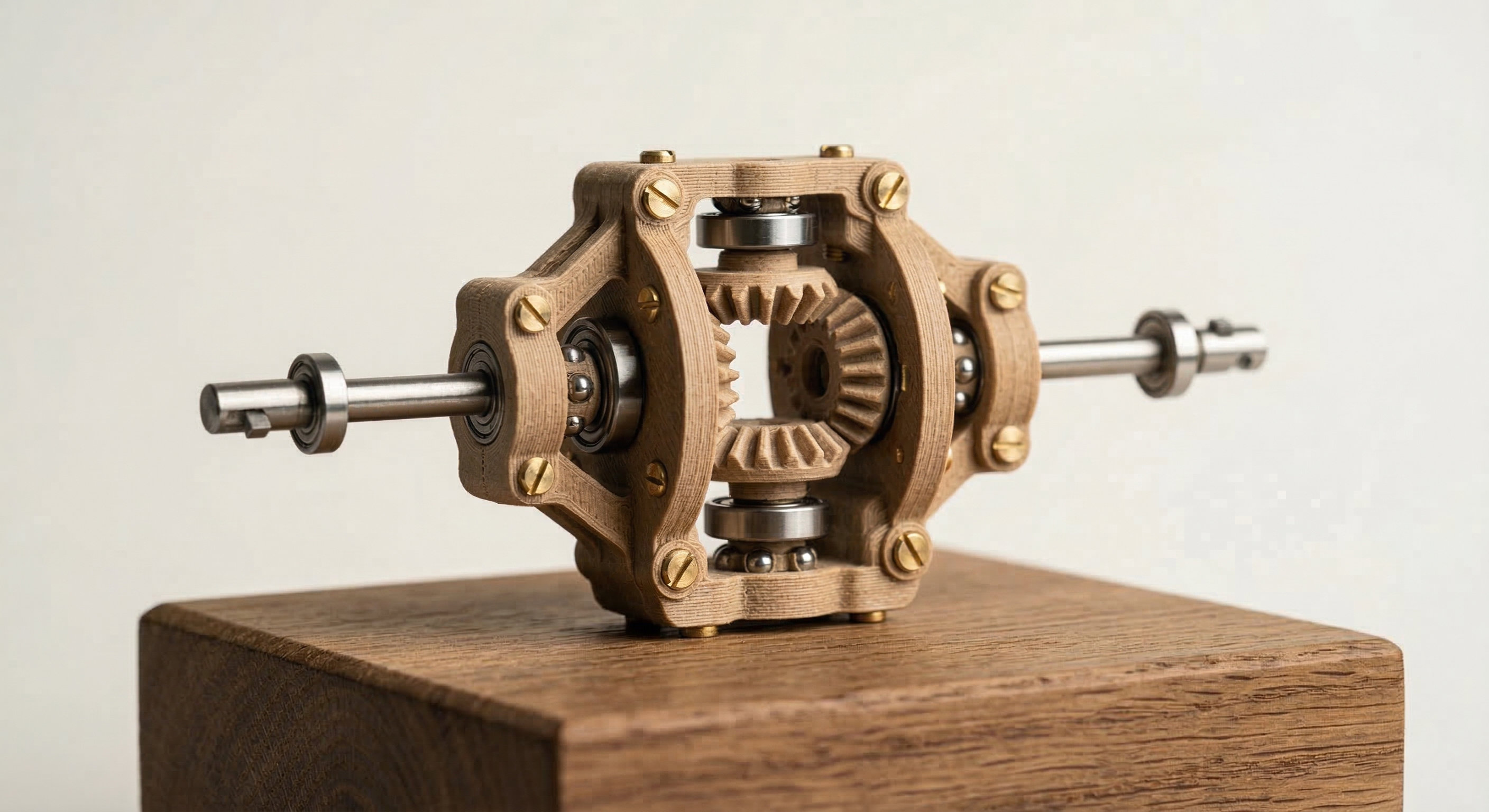
The cornering puzzle
Run the numbers on an ordinary corner. A car follows a quarter circle with a ten-metre radius, measured at the middle of the axle. Its wheels sit a metre and a half apart. The inner wheel follows a 9.25-metre radius and travels about 14.5 metres. The outer wheel follows a 10.75-metre radius and travels nearly 16.9 metres. The gap: almost two and a half metres, on a single corner.
For a cart, no problem: each wheel turns freely on its axle at whatever speed suits it. The trouble starts the day you want an engine to drive the wheels. If the engine turns one rigid shaft carrying both wheels, they must turn together. In every corner, one of them has to slip. On the road, that wears the tyres and makes the steering heavy; on high-grip ground, it can break something.
An old idea, an 1827 patent
The principle has been given distant ancestors. The Chinese “south-pointing chariot”, a legendary vehicle whose figurine always pointed the same way, is often rebuilt today with a differential gear. But its original mechanism has never been found: the modern replicas are hypotheses, not proof.
The first clear patent dates from 1827. The French engineer Onésiphore Pecqueur, trying to get steam carriages moving, protected a gear train able to drive two wheels at different speeds. That is where the word “differential” comes from: the device handles the difference between two speeds. Nearly two centuries later, every car carries at least one.
Anatomy: ring gear, carrier, spider gears, side gears
A classic differential, known as an open differential, brings together four families of parts.
- The ring gear, a large toothed wheel driven by the engine.
- The carrier, fixed to the ring gear, which turns with it.
- The spider gears, small bevel gears mounted inside the carrier, free to spin on their own axis.
- The side gears, two bevel gears facing each other, one for each wheel, meshing with the spider gears.
The engine turns the carrier. The carrier sweeps the spider gears around with it, like planets around a sun, which is why they are also called planet gears. The spider gears in turn push the two side gears. As long as both wheels turn at the same speed, the spider gears do not spin on themselves: the whole assembly turns as one block. As soon as one wheel has to slow down, the spider gears start to roll, and whatever one wheel loses, the other gains.
A rule of absolute simplicity
The differential's entire behaviour fits in one sentence: the carrier speed is always the average of the two wheel speeds. If the carrier turns at 100 rpm, the wheels can turn at 100 and 100, or 90 and 110, or 80 and 120. The sum stays the same.
The extreme case follows on its own. Lock one wheel completely: the other must turn at 200 rpm to keep the average at 100. It runs twice as fast as the carrier. And if you lock the carrier, the two wheels turn in opposite directions at the same speed: you can see it on a jacked-up car left in gear: turn one wheel by hand and the other turns the opposite way.
The other side of the coin
The open differential has a less familiar property: it splits torque equally between the two wheels. As long as both have grip, that is perfect. But put one wheel on ice or in mud: it offers almost no resistance, so the other wheel receives almost nothing either. The slipping wheel spins furiously and the car goes nowhere.
Hence a whole family of fixes. The differential lock, which ties both outputs together on demand, is fitted to off-roaders. Limited-slip differentials send more torque to the wheel that grips. And four-wheel-drive cars often add a third, central differential between front and rear, which do not cover the same distance in a corner either.
A mechanism that can add
Reread the rule: the carrier takes the average of the two outputs. In other words, a differential adds. Engineers grasped this early on, and during the first half of the twentieth century, the mechanical fire-control computers aboard warships lined up dozens of differentials to add and subtract speeds, angles and corrections, until electronics took over.
The same assembly that lets your car turn has therefore also served as a computer. That is the beauty of mechanics: a sound idea resurfaces wherever it can be useful.
On your desk
Our Miniature Differential lays the whole mechanism bare: ring gear, carrier, spider gears and side gears, with no casing to hide them. Sixty-four parts, about twelve centimetres a side, rated intermediate.
Build it, then repeat the three experiments in this article: the straight line, the corner, the locked wheel. In ten seconds you will understand what generations of drivers have used without ever seeing it.
Adrien
Founder and designer of Atlas Kinetics
Adrien draws, prototypes and corrects every mechanism in the catalogue before it goes into production. Here, he shares what he learned by taking them apart.
Meet the workshopThe model: Miniature Differential
64 parts, about 2h30 to build. The mechanism described above turns between your fingers once the last screw is in.
actual size 12 cm
Miniature Differential
€34.20
Power transmission, Alpha series
- Parts
- 64
- Build
- 2 hrs 30 min
- Level
- Intermediate
Read next
All articles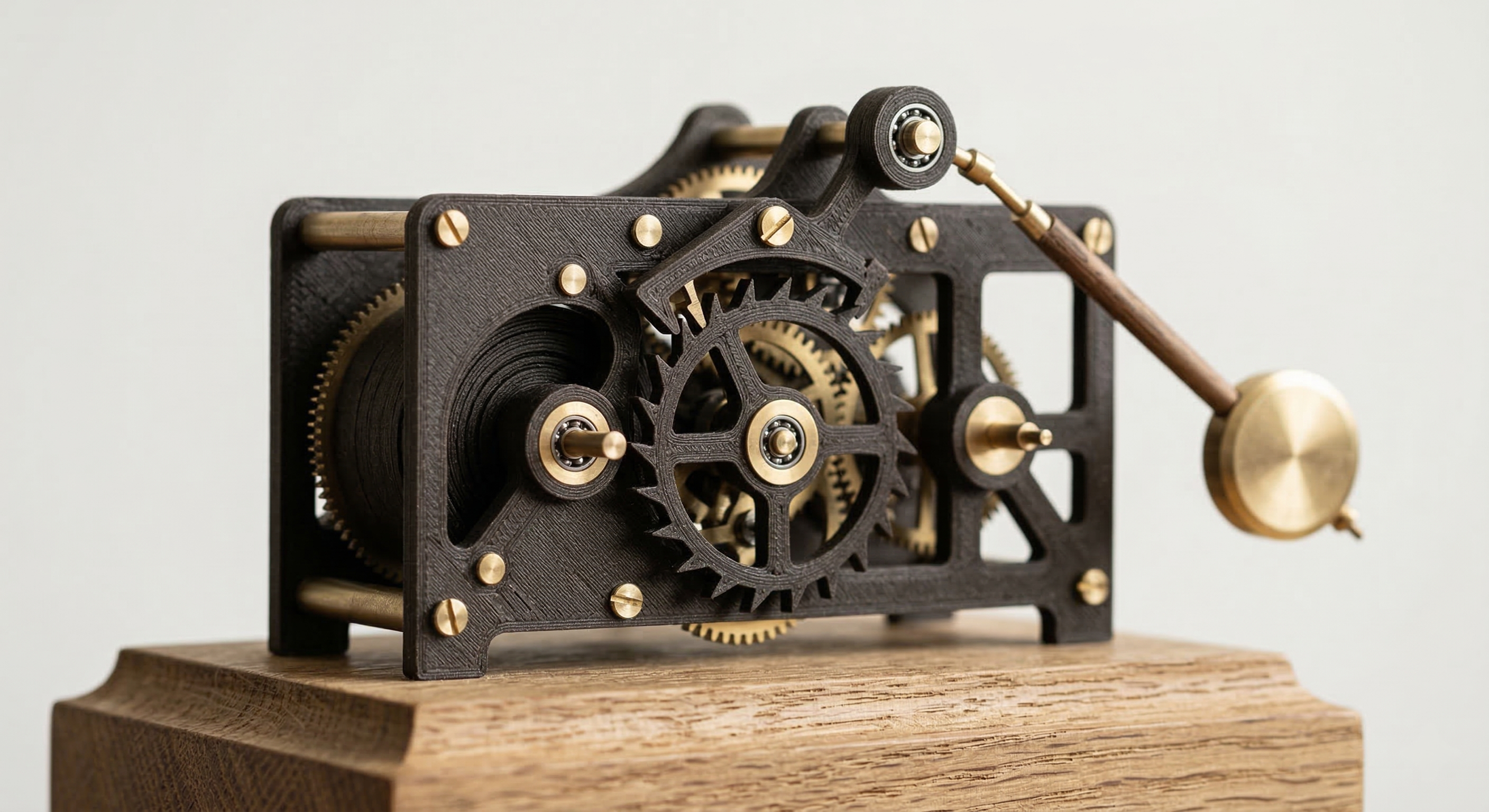
Watchmaking,
The anchor escapement, the part that regulates a pendulum clock
A falling weight does not tell the time. It must be held back and released, tooth by tooth. The history and workings of the anchor escapement.
Read the article (5 min)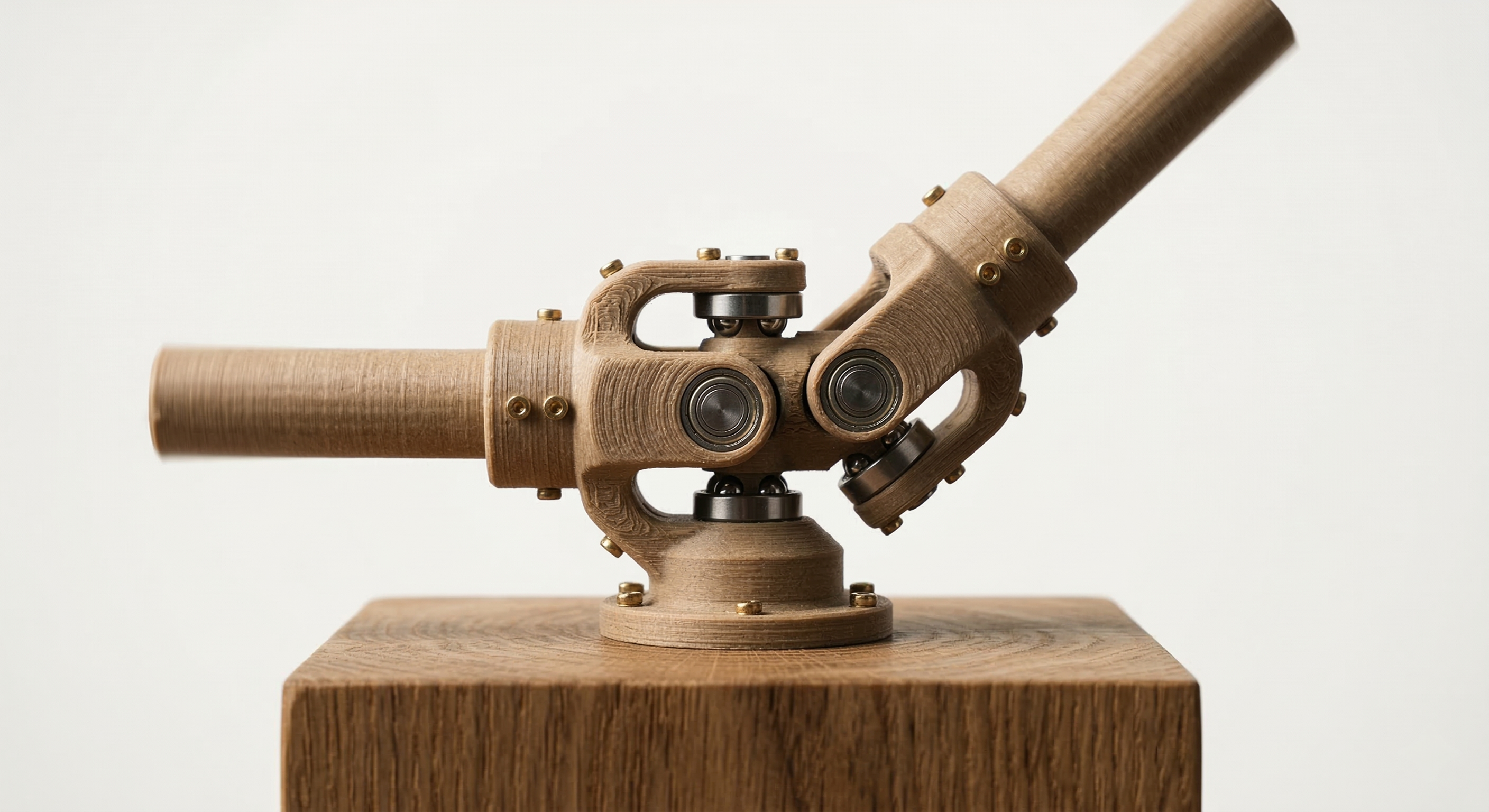
Power transmission,
How a universal joint carries rotation between two shafts out of line
Two shafts out of line, a cross between them, and the rotation carries through. The story and secrets of the joint hidden under trucks and in steering columns.
Read the article (5 min)