Watchmaking
The anchor escapement, the part that regulates a pendulum clock
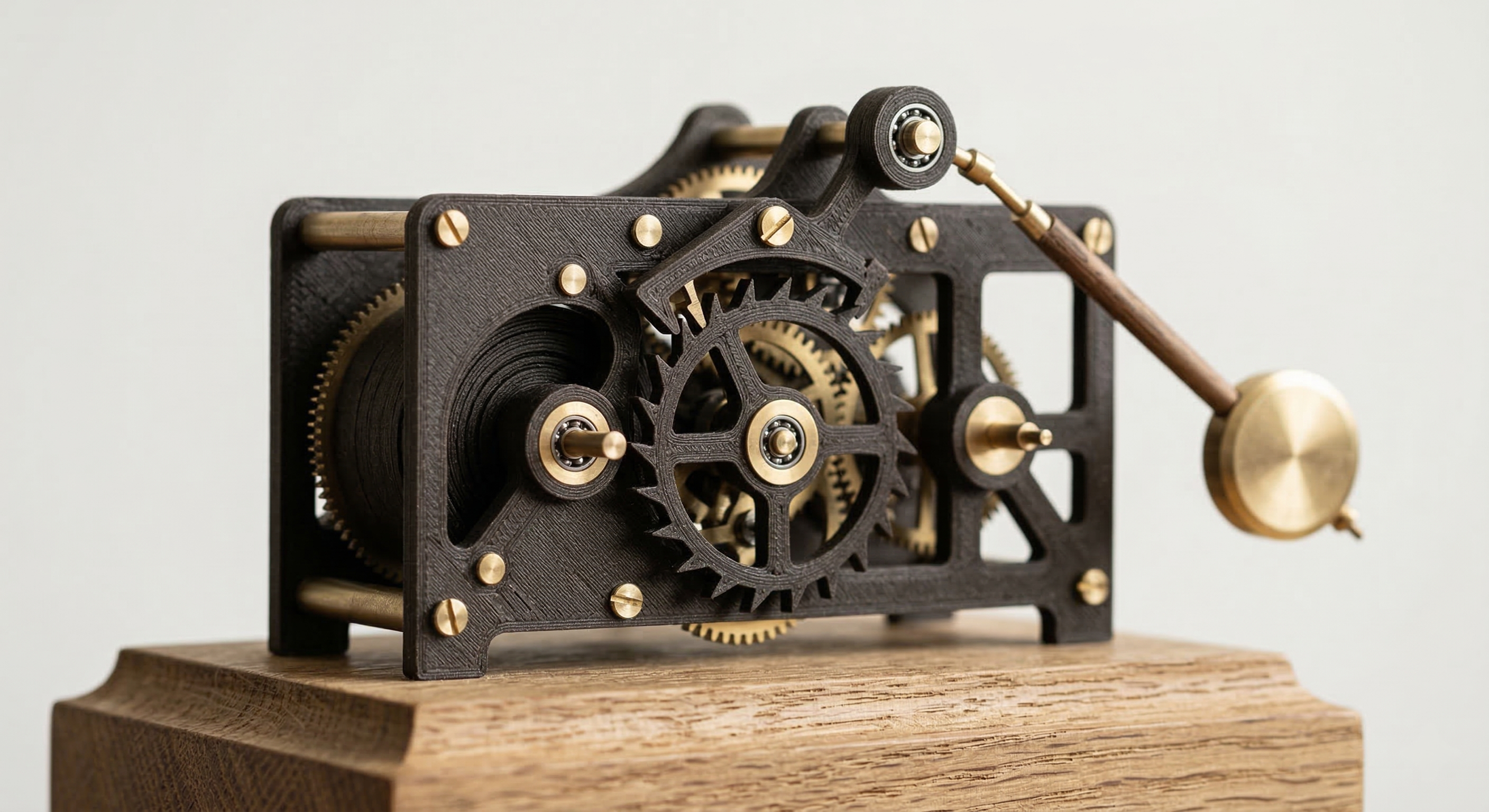
In every mechanical clock, one tiny part does the real work: it holds back the energy and lets it out only in small portions, at regular intervals. That part is called the escapement, and the most common kind is the anchor.
The problem: energy that wants out all at once
A mechanical clock is first of all a store of energy: a weight hanging on a cord, or a coiled spring. Left free, the weight drops in a second and spins the gears at full speed. It measures nothing at all.
To count time, you need two things. An oscillator, beating at as steady a rate as possible. And a part that links this oscillator to the gears: it blocks the wheel, releases it one notch per beat, and in passing hands a flick of energy back to the oscillator so it never stops. That part is called the escapement, because it lets the energy “escape” in small portions. The tick-tock you hear is the escapement.
Before the anchor: the verge and the foliot
The first mechanical clocks appeared in Europe at the end of the thirteenth century, in bell towers and monasteries. Their escapement is called the verge: a crown wheel, toothed like a crown, pushes two pallets on a vertical shaft in turn. At the top of that shaft, a horizontal bar weighted with two small masses, the foliot, brakes each swing with its inertia.
The system works, but the foliot has no natural rhythm of its own: it beats faster or slower depending on the force driving it. These clocks could easily drift by a quarter of an hour a day and had to be reset by the sundial. They often had a single hand, for the hours. Minutes would have to wait for a proper oscillator.
1656: enter the pendulum
Galileo had noticed that a pendulum beats at a rate almost independent of how wide it swings, at least for small swings. In 1656, the Dutch scientist Christiaan Huygens built the first pendulum clock from that idea, patented the following year. The gain was spectacular: errors fell from around a quarter of an hour to about fifteen seconds a day.
But Huygens kept the verge escapement, which forces the pendulum to sweep wide arcs. And the wider the arc, the less regular the pendulum. What was missing was a part content with a swing of just a few degrees.
Around 1670: the anchor changes everything
That part appeared in England around 1670. It is credited to the scientist Robert Hooke or to the clockmaker William Clement, and history has never quite settled the matter. Its shape gives it its name: an arc of metal shaped like a ship's anchor, pivoted in the middle, its two tips carrying beaks called pallets. The anchor is linked to the pendulum and rocks with it, above an escape wheel with slanted teeth.
On every beat, one pallet slips between two teeth and locks the wheel while the other pulls clear. The wheel then advances half a tooth, slides along the slanted face of the pallet and gives it a small push. That impulse is what keeps the pendulum swinging. Lock, release, push: three moves, on every tick and every tock.
With the anchor, the pendulum needs only a few degrees of swing. So it can be made longer. A pendulum just under a metre long, 99.4 centimetres at our latitudes, takes exactly one second to swing from one side to the other: the seconds pendulum. It needed a tall case to house it. The longcase clock was born, and it would keep time in homes for more than two centuries.
Recoil, and the men who banished it
The anchor of Hooke or Clement has a small flaw, visible on any antique clock. When a pallet stops a tooth, the pendulum keeps swinging and pushes the wheel slightly backwards. The seconds hand flinches: this is the recoil escapement. That recoil slightly disturbs the pendulum's regularity.
Around 1715, the English clockmaker George Graham drew pallets whose locking face is an arc centred on the anchor's pivot. The tooth lands on it and waits, motionless, without recoil: the deadbeat escapement. For two centuries it equipped precision regulators, the reference clocks of observatories and clockmakers.
That left the watch, where no pendulum can swing. Around 1755, the Englishman Thomas Mudge adapted the idea to the balance wheel and invented the detached lever escapement: the lever touches the balance only for a brief instant on each swing and leaves it free the rest of the time. Refined over generations, notably in Switzerland, this principle now beats in almost every mechanical watch.
The genius of sharing
What makes the anchor brilliant is the division of labour. The pendulum sets the rhythm, but it has no strength. The weight has all the strength, but no sense of rhythm. The anchor is the interface: on each beat it takes just enough energy to make up for the pendulum's friction, and not a gram more.
The gears only count. If the escape wheel advances one tooth every two seconds, a suitable gear ratio is all it takes for the minute hand to turn once an hour. The whole of mechanical horology fits in that chain: an energy source, an escapement, an oscillator, a counter.
On your desk
Our Simple Anchor Escapement isolates this heartbeat and enlarges it so you can follow it with the naked eye: the wheel, the anchor, its two pallets, and nothing hiding the motion. Forty-eight parts, about sixteen centimetres tall, rated for beginners.
It is the ideal way into mechanical horology. Build it, make it beat, then move on to the Medieval Verge-and-Foliot Clock to travel seven centuries back. You will see with your own eyes what the anchor changed.
Adrien
Founder and designer of Atlas Kinetics
Adrien draws, prototypes and corrects every mechanism in the catalogue before it goes into production. Here, he shares what he learned by taking them apart.
Meet the workshopThe model: Simple Anchor Escapement
48 parts, about 1h30 to build. The mechanism described above turns between your fingers once the last screw is in.
actual size 12 cm
Simple Anchor Escapement
€34.20
Watchmaking, Alpha series
- Parts
- 48
- Build
- 1 hr 30 min
- Level
- Beginner
Read next
All articles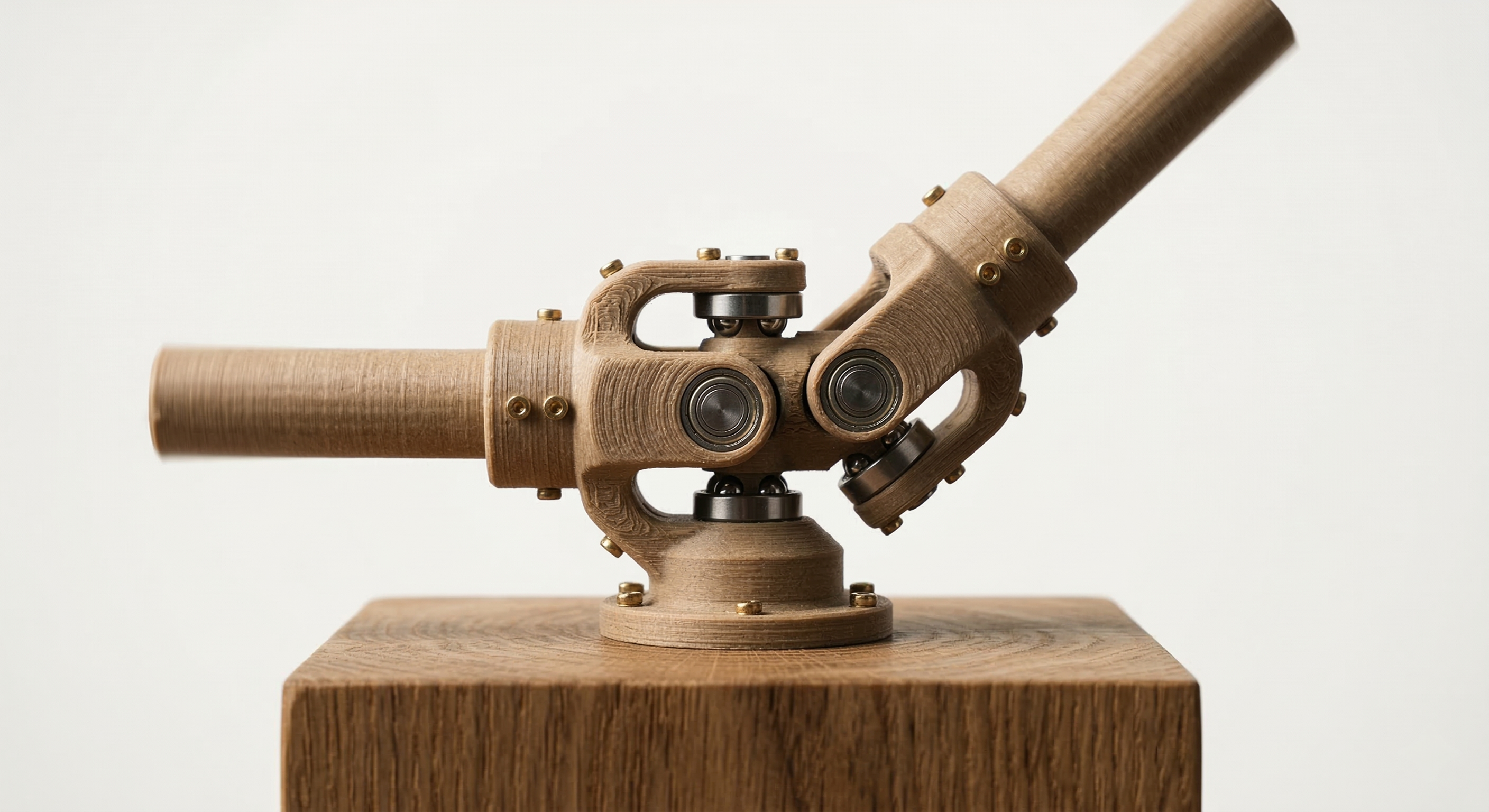
Power transmission,
How a universal joint carries rotation between two shafts out of line
Two shafts out of line, a cross between them, and the rotation carries through. The story and secrets of the joint hidden under trucks and in steering columns.
Read the article (5 min)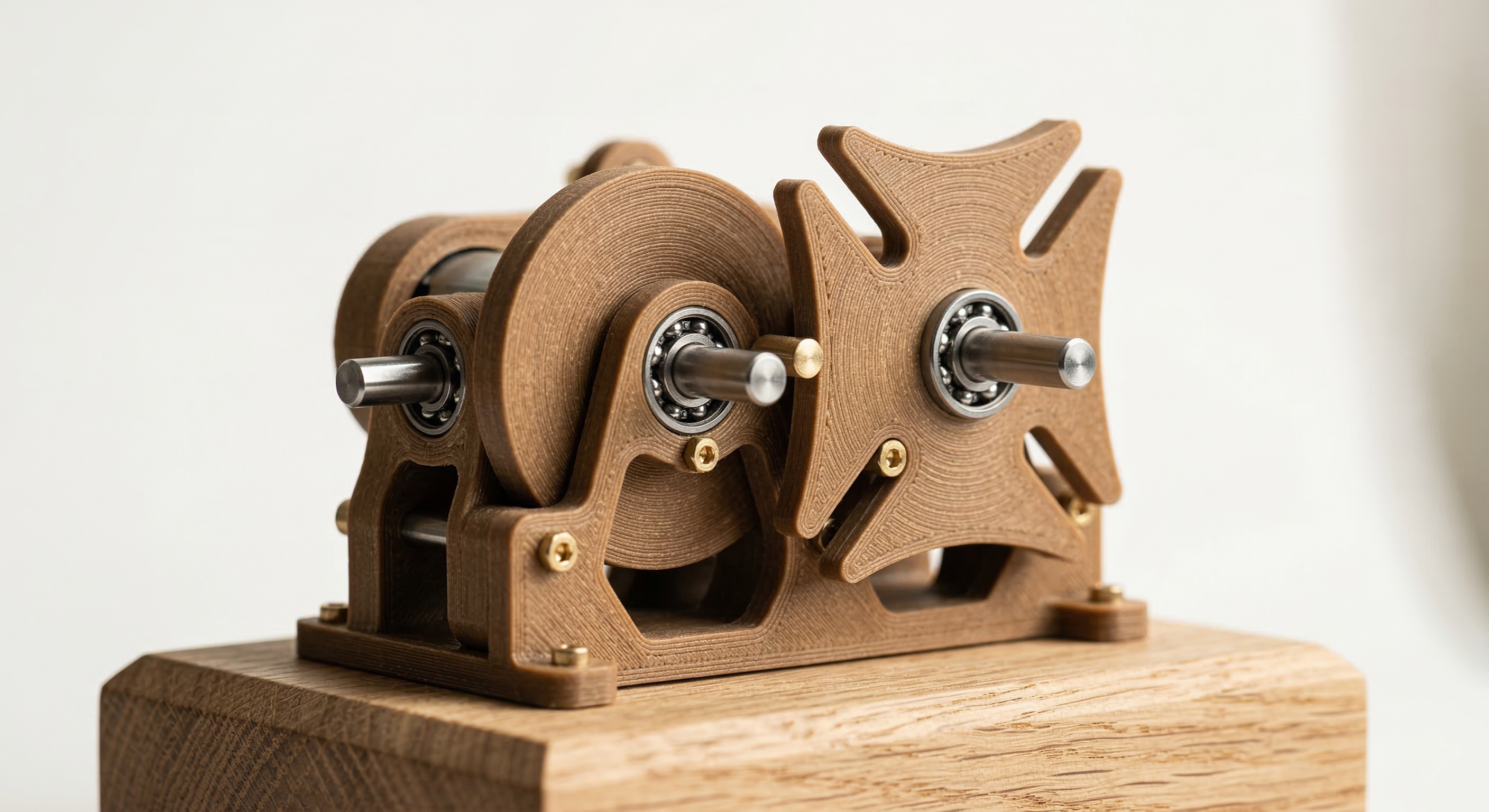
Power transmission,
How the Maltese cross moves film one frame at a time
One wheel turns endlessly, the other steps a quarter turn and locks. The mechanism that ran cinema frame by frame, taken apart piece by piece.
Read the article (5 min)