Astronomy
The orrery, a hand-cranked solar system
A crank, a few gear trains, and the sky starts turning before your eyes. The English clockmakers of the 18th century made it a demonstration piece for learned drawing rooms. The mechanical planetarium, or orrery, shows what the eye cannot see from Earth: the solar system seen from above.
Before the orrery, a shipwreck
The idea of reproducing the sky with toothed wheels is very old. In 1901, sponge divers brought up a corroded lump of bronze from a Greek wreck off the island of Antikythera. It would take decades of study, then X-rays, to understand that it was a geared astronomical calculator, more than two thousand years old, able to predict eclipses.
But the machines of antiquity placed the Earth at the centre of everything. It took Nicolaus Copernicus in 1543 for the Sun to take the central place, then Kepler and Newton for the motion of the planets to be truly understood. Once the heliocentric model was accepted, one question faced the clockmakers: could it be made to turn?
Two clockmakers and an earl
Around 1704, in London, George Graham and Thomas Tompion, the two greatest English clockmakers of their day, built a small machine in which the Earth went round the Sun while the Moon went round the Earth. The instrument maker John Rowley then made a copy for Charles Boyle, 4th Earl of Orrery, an aristocrat with a passion for science.
It was the earl who gave his name to the whole family: ever since, machines that set the solar system turning on a table have been called "orreries". In the 18th century they became the star of public lectures. Around 1766, the English painter Joseph Wright of Derby made one the subject of a famous picture: a scholar demonstrating the orrery to a spellbound audience, their faces lit by a lamp standing in for the Sun.
A living room turned into a sky
The most spectacular planetarium of the age did not come out of a London workshop, but from a house in the Netherlands. In 1774, a preacher announced the end of the world on the occasion of a conjunction of planets. To reassure the people around him, a wool comber with a passion for astronomy, Eise Eisinga, set out to show how the planets really move.
For seven years, he built into the ceiling of his living room a planetarium driven by a pendulum clock, in which every planet moves at its true speed. Completed in 1781, it still runs today in Franeker: it is the oldest working planetarium in the world.
Putting the sky into equations, then into teeth
Building an orrery means translating astronomical periods into numbers of teeth. The Earth goes round the Sun in a little over 365 days. The Moon goes round the Earth in 27.3 days relative to the stars, and returns to the same phase every 29.5 days. Mars completes its orbit in 687 days, almost two Earth years.
Each body therefore gets its own gear train, driven from the crank. The ratio between Mars and the Earth, about 1.88, has to be approximated by fractions of whole numbers, because a wheel cannot carry 1.88 teeth. The designer's whole art lies in finding pairs of wheels simple enough to make and accurate enough that the machine does not visibly drift.
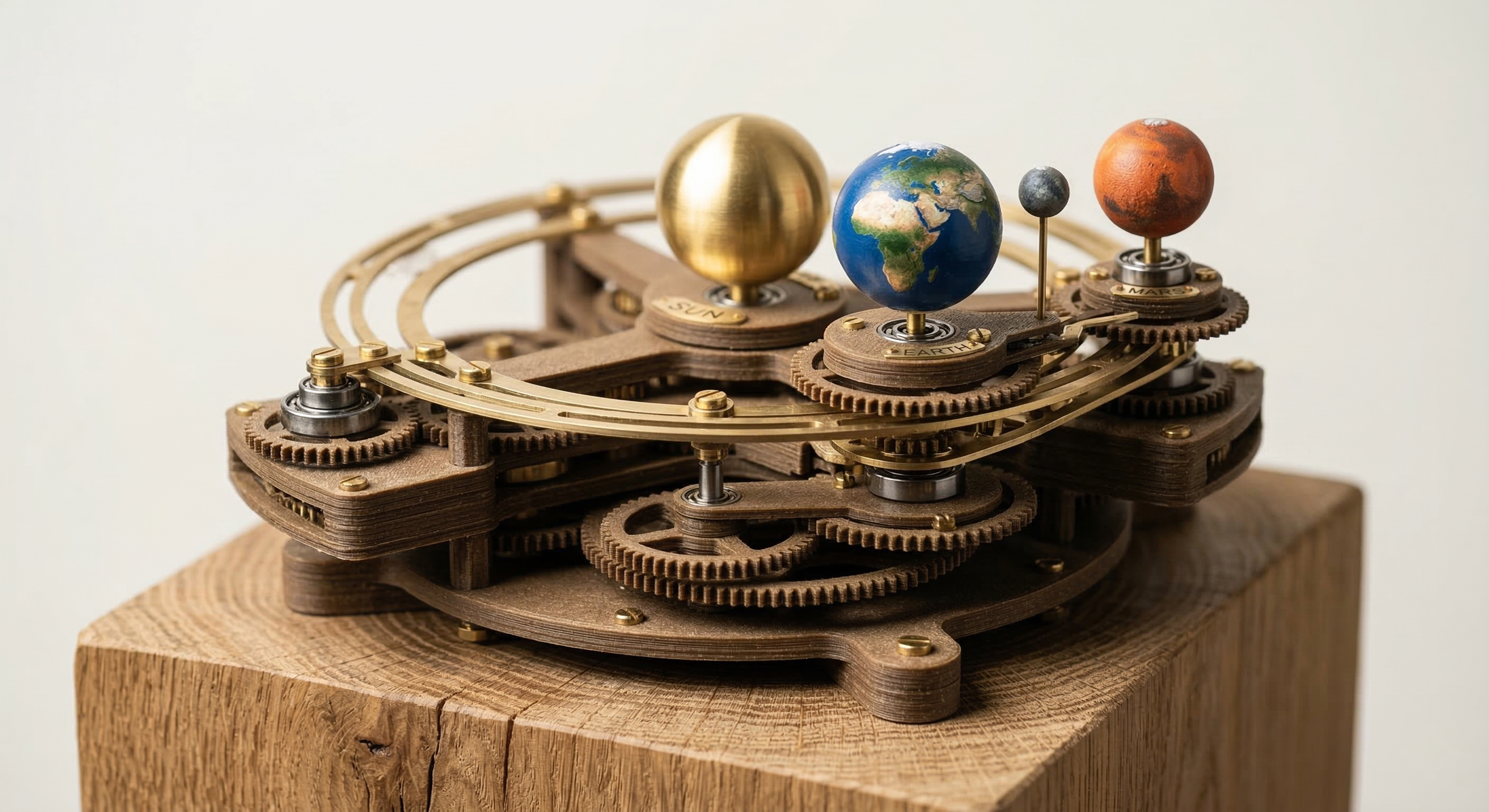
One detail reveals the craft: the Moon. It has to go round the Earth while the Earth itself goes round the Sun. Its mechanism is therefore carried on the Earth's arm, like the planet gears of an epicyclic train, and it has to allow for that arm's motion so that the length of the month stays right.
The necessary lie: scale
No orrery is to scale, and none can be. If the Earth were one centimetre across, the Sun would be a ball about one metre ten wide, more than a hundred metres away. Mars would orbit more than a hundred and fifty metres from the Sun. Impossible on a table.
Makers therefore make a deliberate choice: they respect the periods, not the distances or the sizes. An orrery is not a photograph of the solar system, it is a clock. It tells you when each body will be where, not how far away it is.
Why Mars goes backwards
This is where the orrery becomes a tool for understanding. Seen from Earth, Mars sometimes seems to stop in the sky, move backwards for several weeks, then resume its course. This retrograde motion puzzled astronomers for centuries and forced the geocentric model to pile circle upon circle.
On the orrery, the explanation leaps out. The Earth, closer to the Sun, travels faster than Mars. Roughly every twenty-six months, it catches up and overtakes Mars on the inside, like a runner on the bend of a track. During that overtaking, seen from Earth, Mars seems to slide backwards against the background stars.
On your desk
Our Solar Orrery brings the Sun, the Earth, the Moon and Mars together in a single mechanism: 230 parts, 30 × 30 × 22 cm, an expert-rated build of about ten hours. It is one of the masterpieces of the catalogue, and one of the most generous: every gear has an astronomical reason to exist.
Take your time building it, then turning it. Three centuries after Graham and Tompion, the pleasure is intact: watching the sky obey a crank.
Adrien
Founder and designer of Atlas Kinetics
Adrien draws, prototypes and corrects every mechanism in the catalogue before it goes into production. Here, he shares what he learned by taking them apart.
Meet the workshopThe model: Solar Orrery
230 parts, about 10h to build. The mechanism described above turns between your fingers once the last screw is in.
actual size 30 cm
Solar Orrery
€76.50
Astronomy, Omega series
- Parts
- 230
- Build
- 10 hrs
- Level
- Expert
Read next
All articles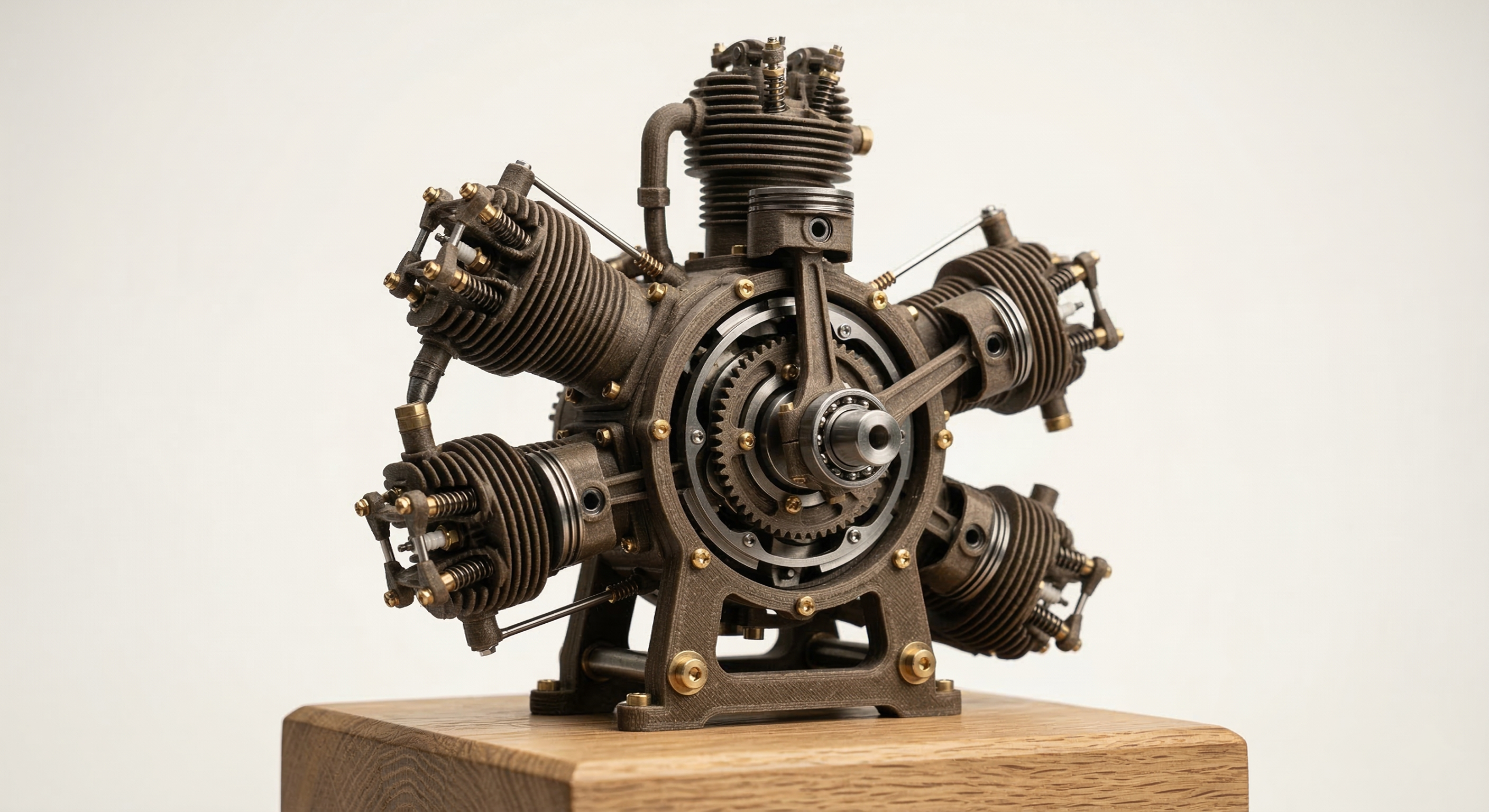
Thermodynamics,
The radial engine, cylinders in a star around a single crankshaft
Cylinders in a star, a master rod, an odd number of cylinders: the engine that crossed the Atlantic and carried the first airliners.
Read the article (5 min)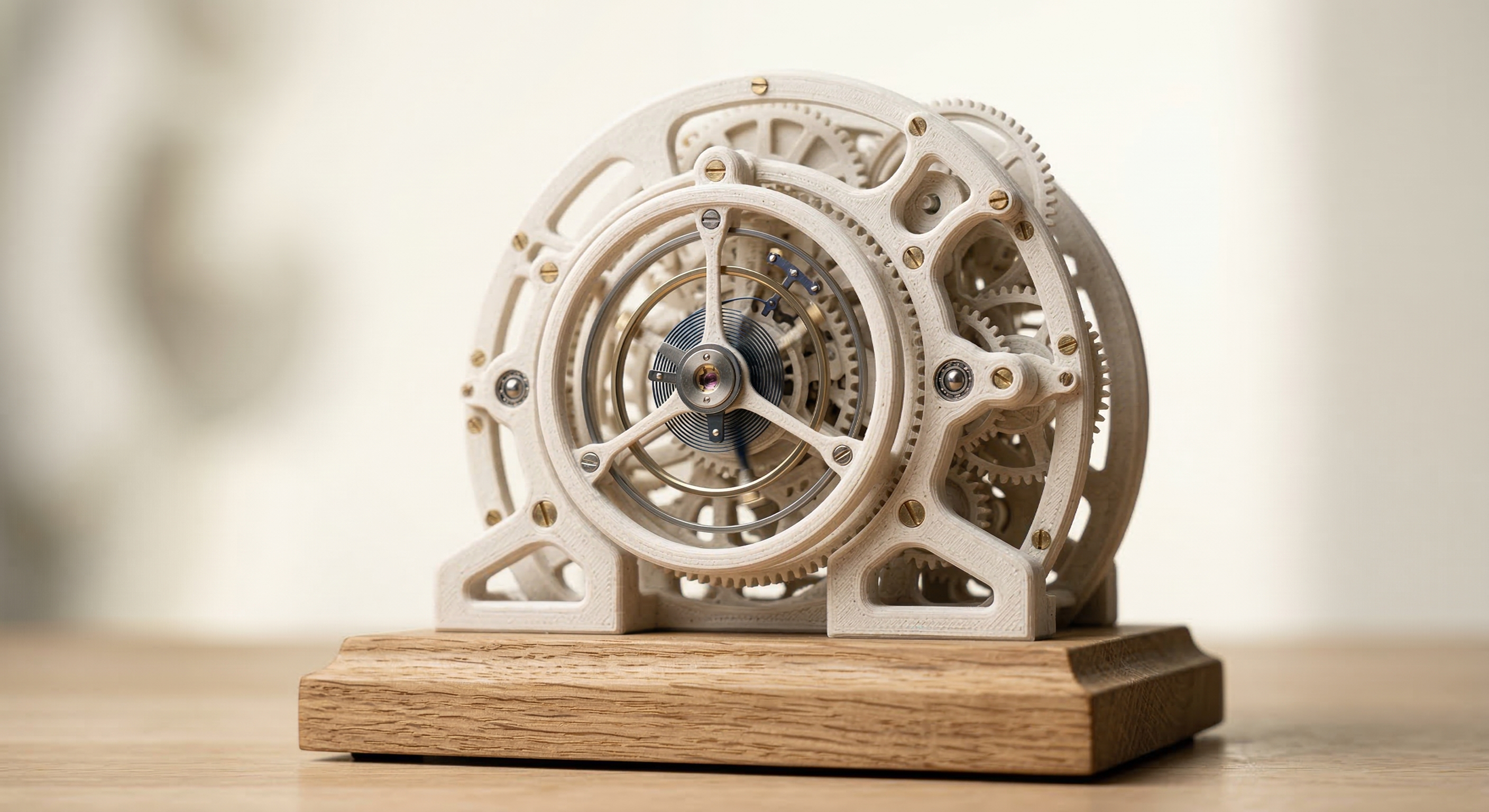
Watchmaking,
Breguet's tourbillon (1801) and gravity in a pocket watch
In 1801, Breguet set the whole heart of a watch spinning on itself to cancel out gravity. The history and mechanics of the king of complications.
Read the article (4 min)