Thermodynamics
The radial engine, cylinders in a star around a single crankshaft
Look at an aircraft from the 1930s head-on: behind the propeller, a ring of cylinders bristling with fins. For thirty years the star engine was the heart of aviation, from mail planes to airliners. You can read its mechanics at a single glance.
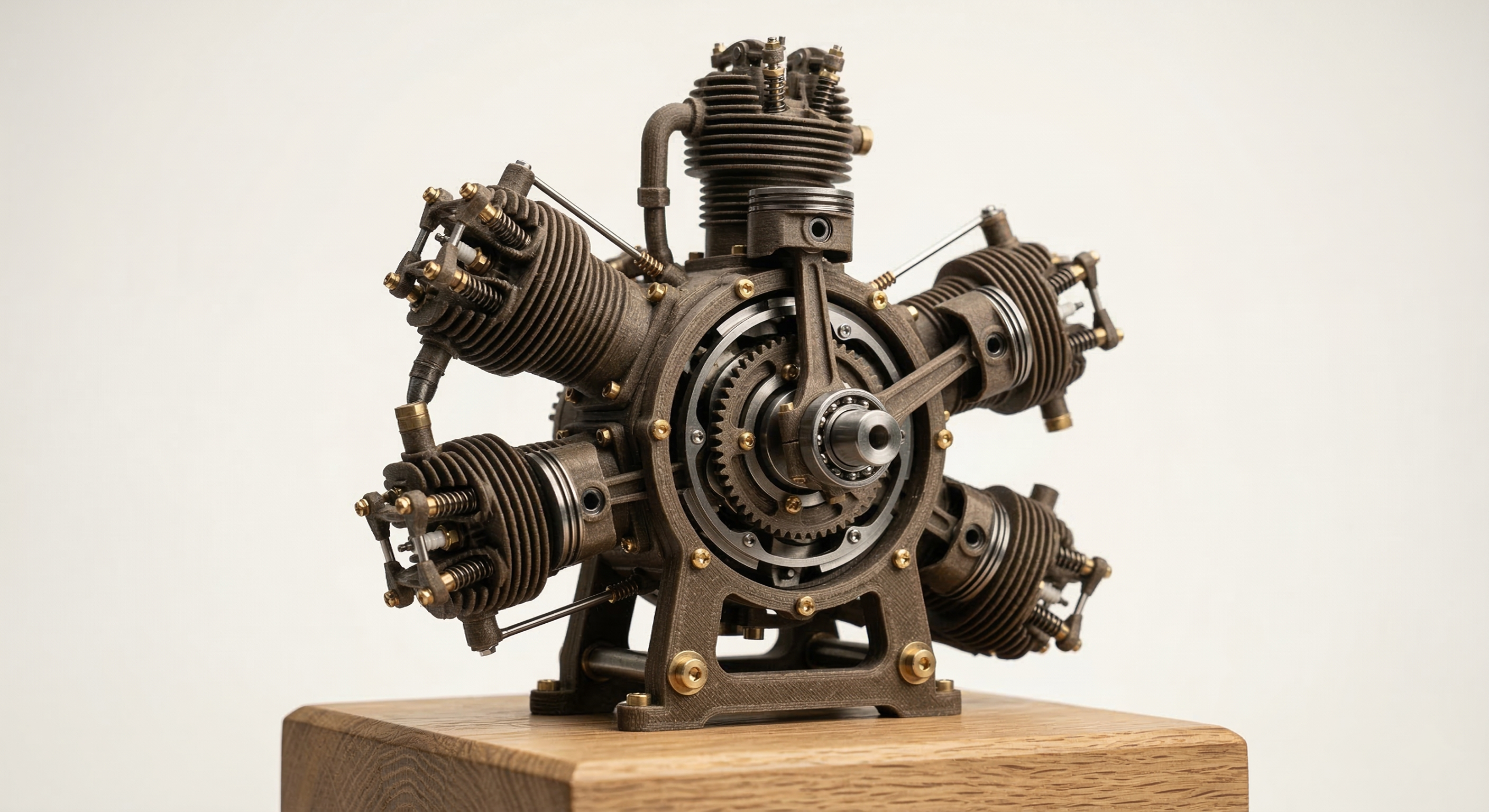
A star of cylinders
In a car engine, the cylinders stand one behind the other, or in a V. In a radial engine, they radiate around the crankshaft like the points of a star, all in the same plane. The engine is short, compact, almost flat, and every cylinder faces straight into the wind.
For aviation, the layout pays off. A single crankcase and a very short crankshaft serve every cylinder, so the engine is light for its power, and it is tough. Most of all, it cools itself: the air driven by the propeller strikes the finned cylinders directly, with no radiator, no pump and no coolant to leak at the first knock.
First steps: from Manly to rotary engines
One of the very first aircraft engines was already a radial. In the early 1900s, the American engineer Charles Manly built a water-cooled five-cylinder star engine for Samuel Langley's Aerodrome. The engine was remarkable, the aircraft much less so: it plunged into the Potomac in December 1903, nine days before the Wright brothers' first flight.
A few years later, the Seguin brothers launched the Gnome, a rotary engine: the crankshaft was fixed to the aircraft, and the cylinders themselves spun with the propeller. The idea sounds mad, but the engine cooled perfectly. During the First World War, rotaries powered a host of fighters. Their spinning mass acted like a huge gyroscope: some aircraft turned far faster one way than the other.
The golden age: 1920-1950
The rotary engine soon hit a ceiling: beyond a certain power, spinning the whole engine became untenable. In the 1920s the fixed radial took over, with stationary cylinders. In 1927, a nine-cylinder Wright Whirlwind powered Charles Lindbergh's Spirit of St. Louis on the first solo non-stop crossing of the Atlantic. At the end of the decade, a streamlined cowling developed in the United States by NACA sharply cut the drag of these engines while improving their cooling.
Radials then powered airliners such as the Douglas DC-3, flying boats and bombers. To gain power without widening the engine, manufacturers stacked the stars: two rows, then four. The Pratt & Whitney R-4360 lined up twenty-eight cylinders in four stars of seven. After 1950 the jet engine took over, but the radial still flies, on vintage, crop-spraying and aerobatic aircraft.
One crankpin for every piston
The mechanical challenge of the radial comes down to one question: how do you connect five pistons, or nine, to a crankshaft with only one crankpin per star? The answer is the master rod. A single piston is joined to the crankpin by a conventional connecting rod, heavier than the others. On the big end of that rod, all around the crankpin, the articulated rods of all the other cylinders are hinged.
As the crankshaft turns, the big end of the master rod traces a circle and carries all the articulated rods with it. Each piston rises and falls in turn in its cylinder. Because the articulated rods are pinned next to the crankpin rather than on it, their pistons do not have quite the same stroke: a difference engineers know how to compensate for in the design of the parts.
Why always an odd number
Count the cylinders of a single-row radial: five, seven, nine. Almost never an even number. The reason lies in the four-stroke cycle: intake, compression, power, exhaust. Each cylinder fires only once every two turns of the crankshaft.
For the engine to run smoothly, the firing strokes must be evenly spaced. With an odd number of cylinders, the fix is simple: fire every other cylinder. On a five-cylinder engine, the order is 1-3-5-2-4. On the first turn, cylinders 1, 3 and 5; on the second, cylinders 2 and 4. That gives one firing every 144 degrees of crankshaft rotation, evenly spaced. With an even number, skipping every other cylinder would always land on the same ones, and the other half would never fire at the right moment.
The valves: a conductor at the centre
That leaves opening and closing two valves per cylinder, at the right moment, for five cylinders spread all around the engine. On a radial, the job falls to a cam plate turning slowly at the centre, at a fraction of crankshaft speed. Its lobes push the tappets, which work the pushrods and the rocker arms perched on top of each cylinder.
A single central part thus controls the entire valve train. That is what makes a radial so readable: the pushrods radiate from the crankcase to each cylinder head, like a second star drawn over the first.
On your desk
Our 5-Cylinder Radial Engine reproduces the whole choreography, seen head-on: pistons, master rod, articulated rods, valves. No fuel and no flame: you drive the crankshaft yourself, and every part moves as it does in the real engine. 220 parts, 22 × 22 × 16 cm, an expert-rated build of about ten hours.
If you like aircraft, start here: one slow turn of the crankshaft shows the master rod, the firing order and the valve train at work.
Adrien
Founder and designer of Atlas Kinetics
Adrien draws, prototypes and corrects every mechanism in the catalogue before it goes into production. Here, he shares what he learned by taking them apart.
Meet the workshopThe model: 5-Cylinder Radial Engine
220 parts, about 10h to build. The mechanism described above turns between your fingers once the last screw is in.
actual size 22 cm
5-Cylinder Radial Engine
€72.00
Thermodynamics, Omega series
- Parts
- 220
- Build
- 10 hrs
- Level
- Expert
Read next
All articles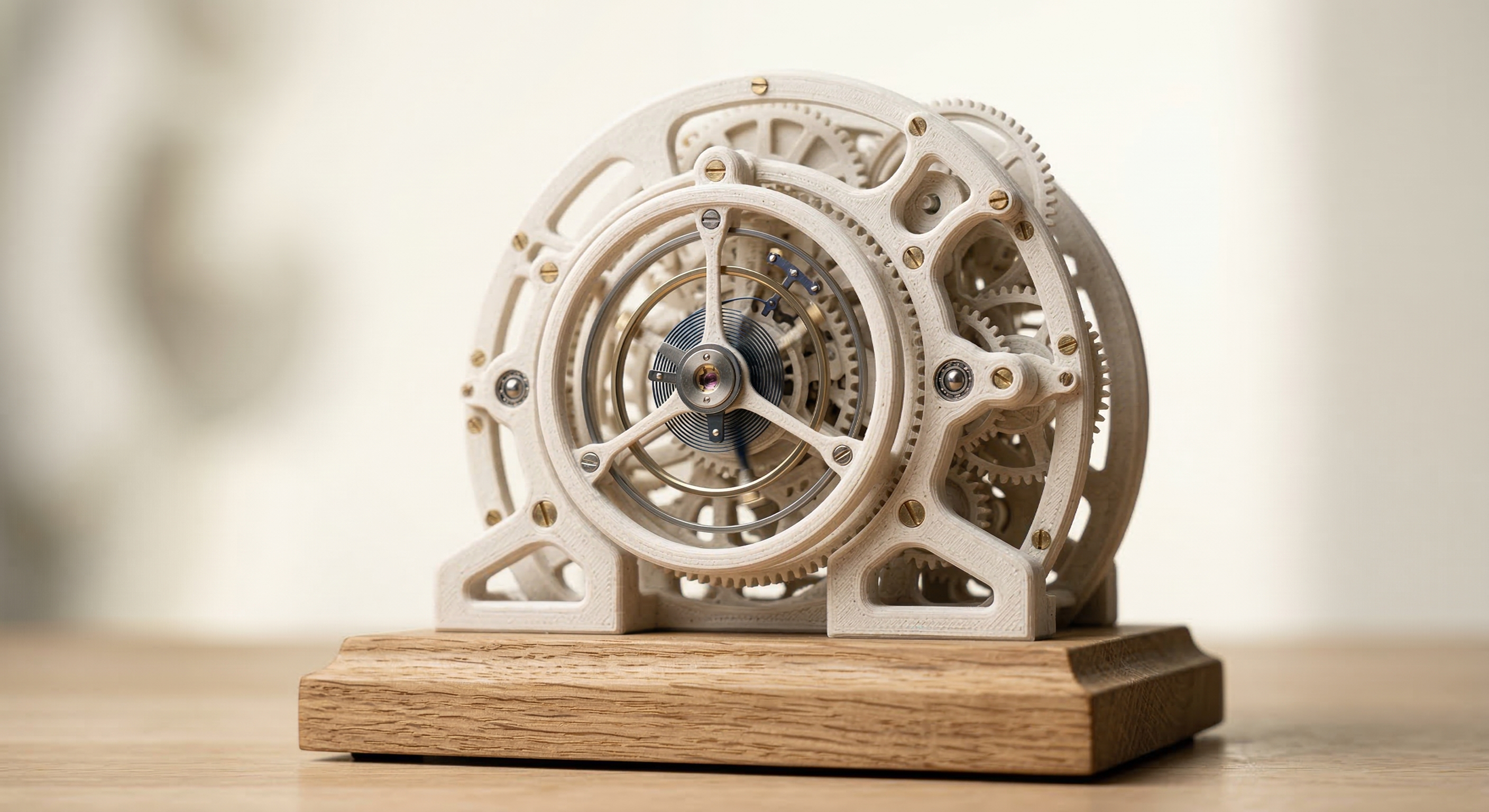
Watchmaking,
Breguet's tourbillon (1801) and gravity in a pocket watch
In 1801, Breguet set the whole heart of a watch spinning on itself to cancel out gravity. The history and mechanics of the king of complications.
Read the article (4 min)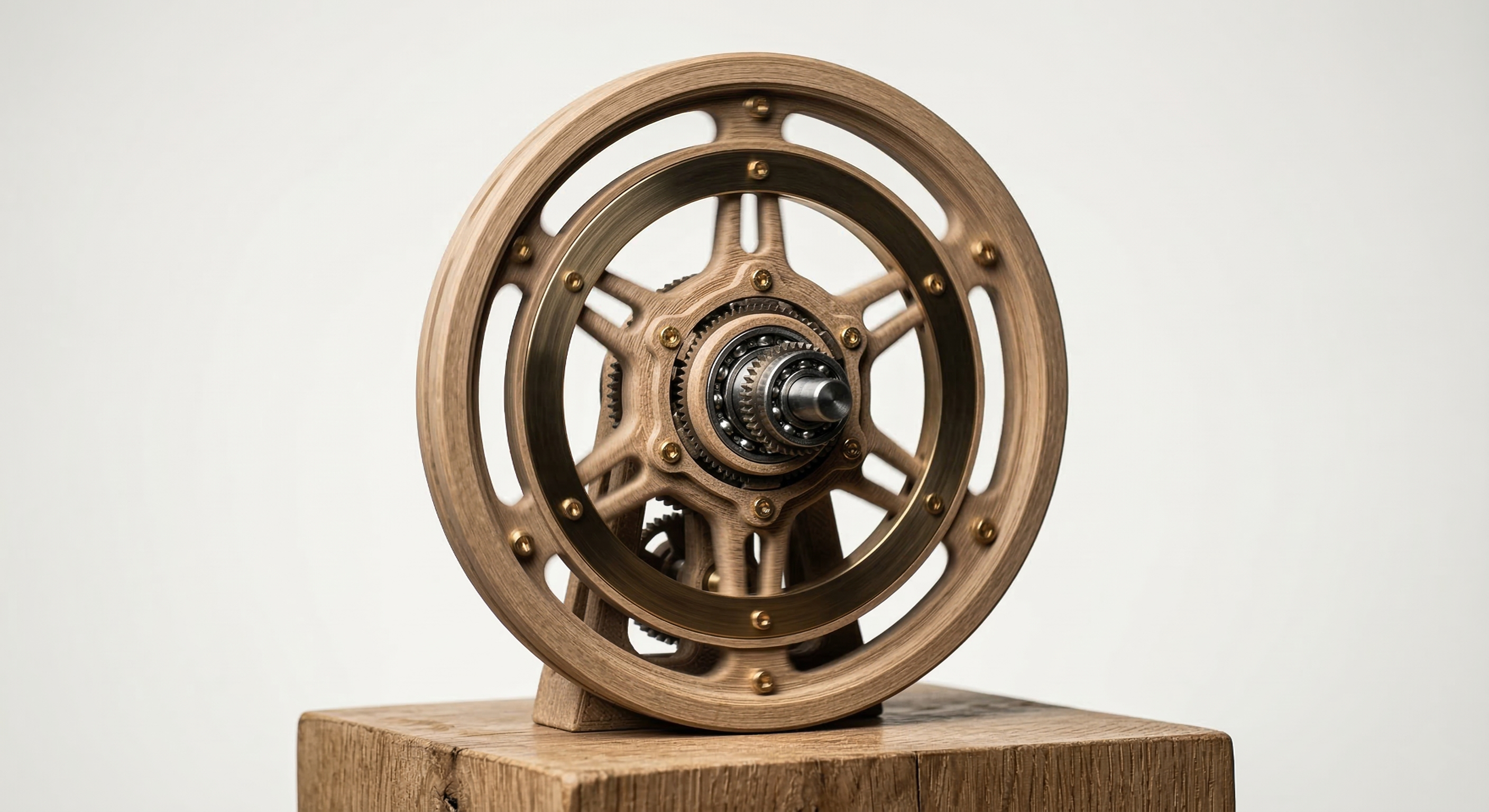
Physics,
Why a spinning gyroscope does not fall over
Spun up to speed, a disc refuses to tip and swings sideways when you push it. From Foucault's experiment to the navigation of aircraft and satellites.
Read the article (4 min)