Power transmission
How a universal joint carries rotation between two shafts out of line
One shaft turns, the other is tilted, and yet the rotation passes from one to the other. The universal joint has done this job for more than three centuries, in trucks, tractors and steering columns. It also hides a flaw that engineers have learned to turn against itself.
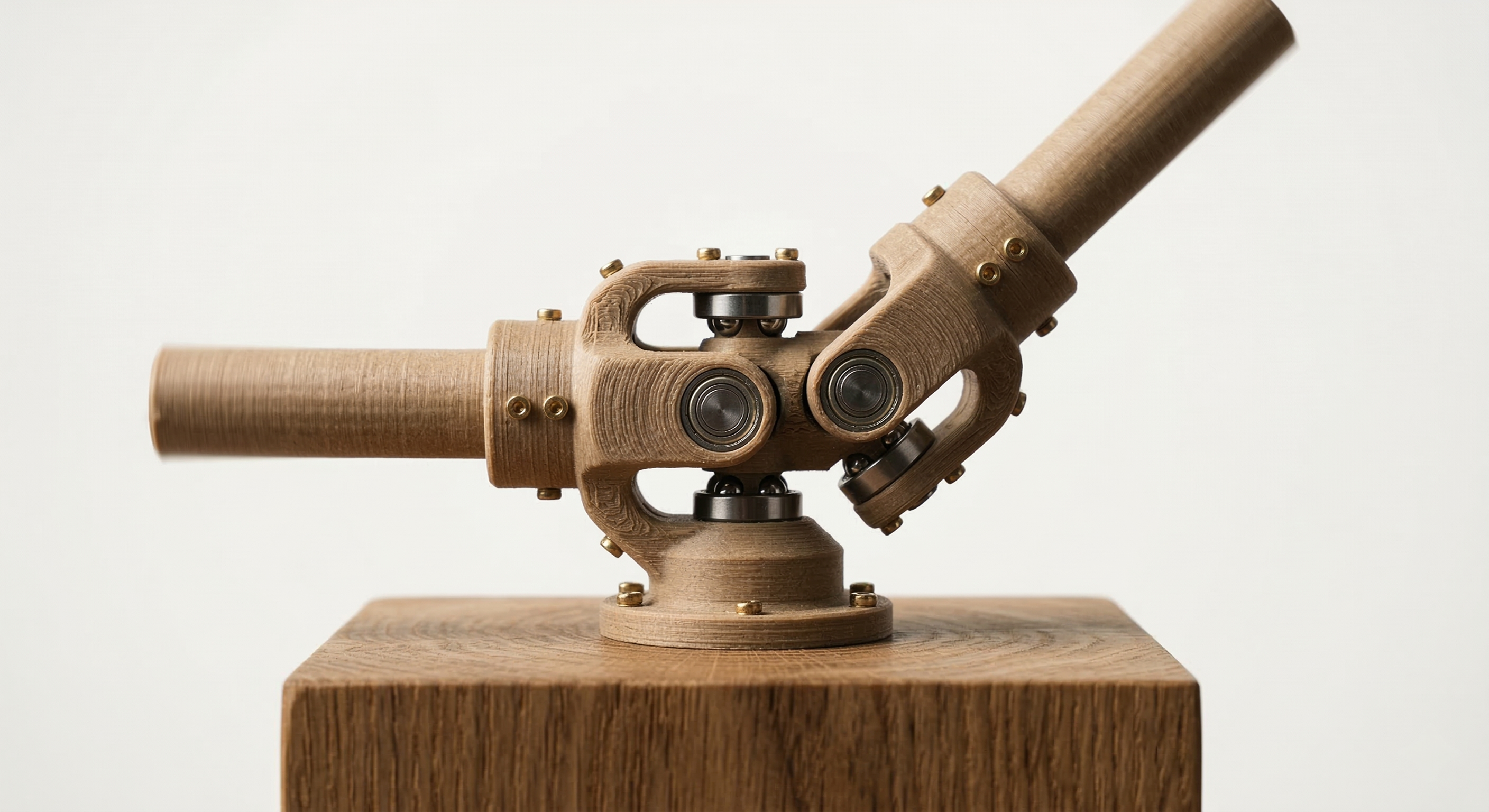
Turning what is not in line
In an ideal machine, every shaft would be perfectly in line. In reality, they almost never are. A truck's engine is bolted to the chassis, while the rear axle rises and falls with the suspension. A car's steering wheel sits in front of the driver, the steering box much lower, near the wheels. In between, rotation has to pass through an angle, and that angle keeps changing.
A rigid shaft would break. A spring or a flexible hose would not carry enough torque. What you need is a joint that lets the two shafts pivot relative to each other while forcing them to turn together. That is exactly what the universal joint does, with four pivots and a small cross.
Cardano gave the name, Hooke made the joint
The story begins with a suspension, not a transmission. The Greek engineer Philo of Byzantium is credited with describing an inkwell mounted in nested rings, which stays upright however you turn it. The principle travelled down the centuries: rings hinged at 90 degrees to one another isolate an object from the movements of its support.
In the 16th century, the Italian scholar Girolamo Cardano, physician, mathematician and inveterate gambler, described this suspension in his writings. He did not invent it, but his name stuck: in French and German the joint is still called a "cardan", and the gimbal that keeps ships' compasses and marine chronometers level bears his name in many languages.
The decisive step came from England. Around 1676, the physicist Robert Hooke, the most wide-ranging mind of the Royal Society, published a joint that no longer held an object still, but carried rotation between two inclined shafts. He intended it for pointing observing instruments. English speakers still call it "Hooke's joint", the French call it a "cardan": two names for one object.
Two yokes, one cross, four pivots
The joint comes down to three main parts. At the end of each shaft, a yoke. Between the two yokes, a cross, the spider, whose four arms turn in four bearings. Two opposite arms are held by the first yoke, the other two by the second. The two yokes are therefore set 90 degrees apart.
When the input shaft turns, its yoke drives the cross. The cross, free to rock on its pivots, in turn drives the second yoke, even though it points in another direction. Each shaft makes one full turn for each turn of the other: over a complete revolution, nothing is lost. Everything happens within the turn.
The hidden flaw: a speed that ripples
That rocking has a consequence Hooke had already noticed. If the input shaft turns at a perfectly steady speed, the output shaft does not. It speeds up, slows down, speeds up again, twice per turn. Engineers say the joint is not constant-velocity.
The deviation depends on the angle between the shafts. At 10 degrees, it is barely 1.5%, invisible. At 30 degrees, the output speed swings between about 87% and 115% of the input. At 45 degrees, between 71% and 141%. The limits are easy to remember: the cosine of the angle, and its inverse.
For a slowly turning shaft, this does not matter. For a drive shaft spinning at several thousand revolutions per minute, those jolts become vibration, wear and noise. A single universal joint at a steep angle shakes everything behind it.
The cure: two flaws that cancel out
The solution is remarkably elegant: instead of removing the flaw, you double it. Two universal joints are fitted in series, linked by an intermediate shaft. The first makes the intermediate shaft's speed ripple; the second, fitted the right way round, does exactly the opposite. At the output, the speed is steady again.
Two conditions are enough. Both angles must be equal. And the two yokes on the intermediate shaft must lie in the same plane, lined up with each other. Fit them a quarter turn apart and the two irregularities add up instead of cancelling: a classic trap, and a good reason to mark the parts before taking a drive shaft apart.
This is the layout you see under trucks and rear-wheel-drive cars: a long shaft with a joint at each end. You also find it in steering columns, where one or two joints let the steering wheel reach the steering box by going around the engine and the pedals.
After the universal joint: constant-velocity joints
For driven front wheels, the universal joint reaches its limits. A wheel that steers and follows the suspension imposes large angles, all the time, right where the torque is highest. In the 1920s, engineers developed truly constant-velocity joints. The most famous, by Alfred Rzeppa, carries the torque through balls set in grooves: whatever the angle, they settle in the plane that bisects it, and the output follows the input without rippling.
These joints are now fitted to almost every front-wheel-drive car. The universal joint has not disappeared for all that. It remains unbeatable for simplicity and toughness: truck and tractor drive shafts, farm power take-offs, steering columns, machine tools. Four pivots, one cross, and the job is done.
On your desk
Our Compact Cardan Joint takes the mechanism in its purest form: two yokes, one cross, four pivots. Twenty-eight parts, 8 × 8 × 14 cm, a beginner-rated build of about an hour. The output shaft tilts up to 45 degrees: enough to see with the naked eye the flaw that textbooks only put into equations.
An ideal first kit, and a great conversation piece: your car very probably hides one, just below the steering wheel.
Adrien
Founder and designer of Atlas Kinetics
Adrien draws, prototypes and corrects every mechanism in the catalogue before it goes into production. Here, he shares what he learned by taking them apart.
Meet the workshopThe model: Compact Cardan Joint
28 parts, about 1h to build. The mechanism described above turns between your fingers once the last screw is in.
actual size 8 cm
Compact Cardan Joint
€31.50
Power transmission, Alpha series
- Parts
- 28
- Build
- 1 hr
- Level
- Beginner
Read next
All articles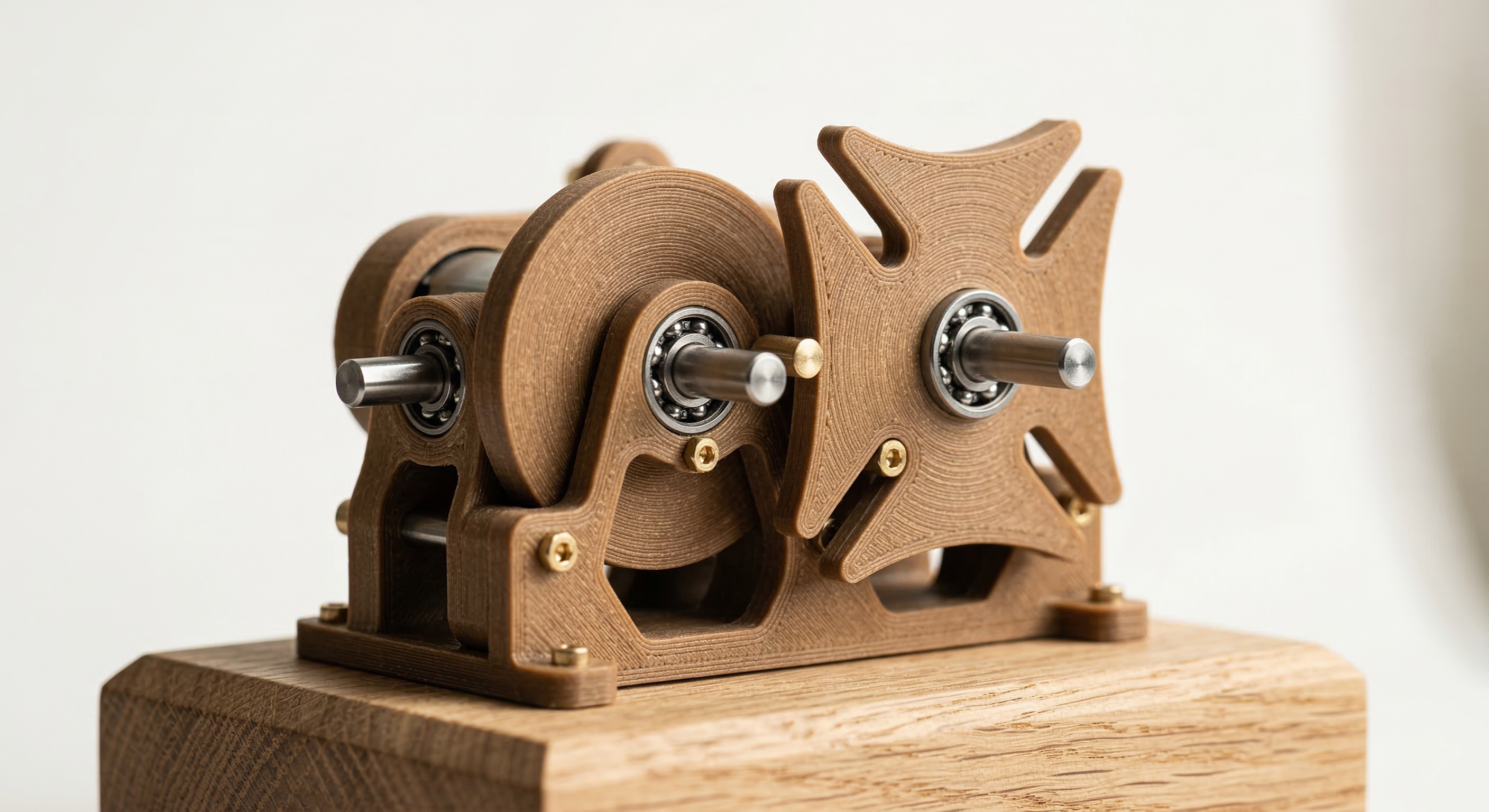
Power transmission,
How the Maltese cross moves film one frame at a time
One wheel turns endlessly, the other steps a quarter turn and locks. The mechanism that ran cinema frame by frame, taken apart piece by piece.
Read the article (5 min)
Astronomy,
The orrery, a hand-cranked solar system
Turn a crank and the Earth circles the Sun, the Moon circles the Earth. Three centuries of mechanical planetaria, from London to your desk.
Read the article (4 min)