Power transmission
How the Maltese cross moves film one frame at a time
One wheel never stops turning. The other jumps forward, freezes, then jumps again. This mechanism pulled miles of film through projectors and protected the mainsprings of antique watches. Here is how it works.
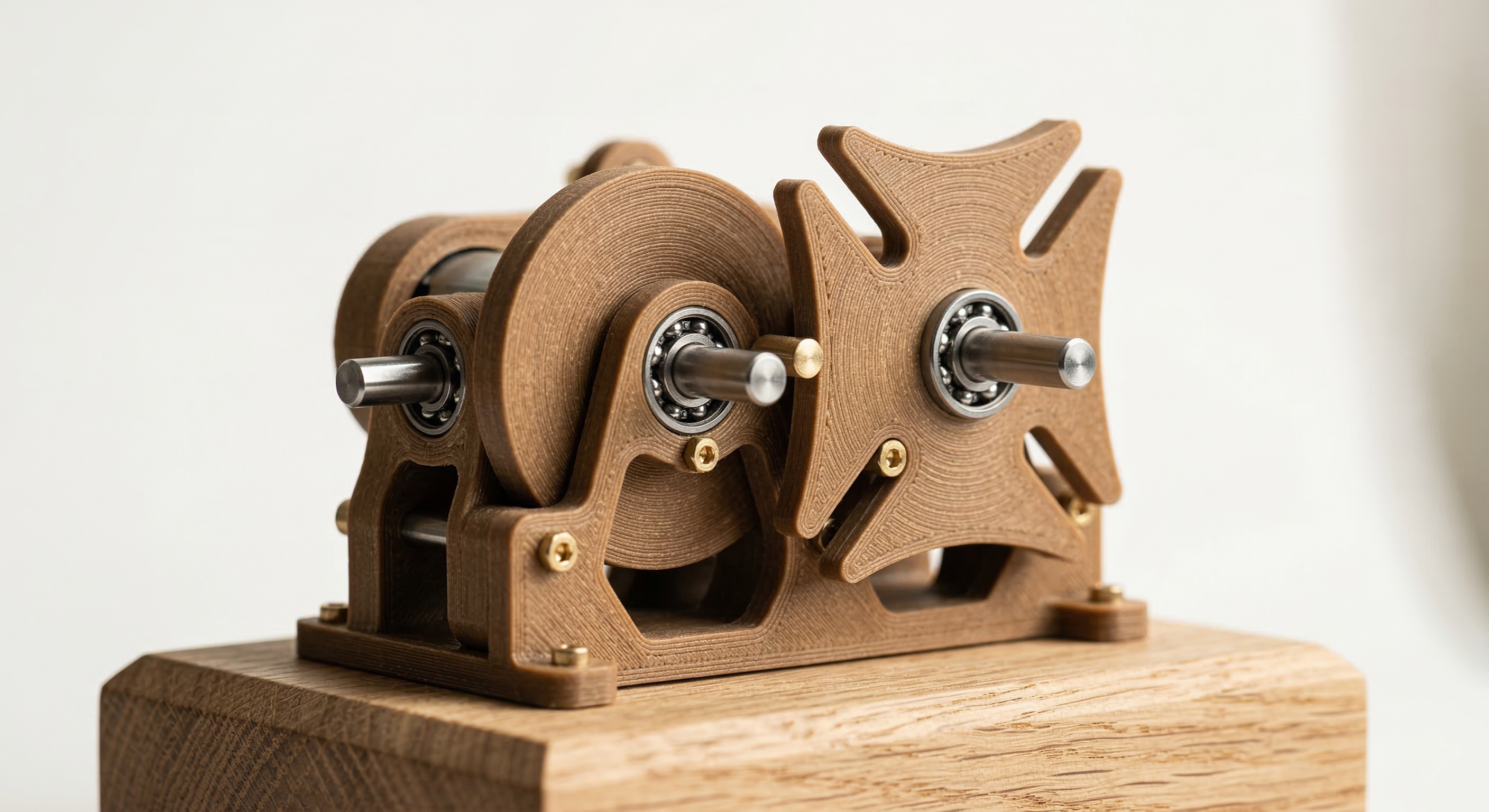
Move, then stop dead
An engine, a crank, a turbine: almost everything that produces motion produces it continuously. Yet many machines need the opposite: move one notch, pause, move again. A strip of film must sit still in front of the lamp, a turntable presents one bottle under the filling nozzle and then the next, a counter jumps from one digit to the next.
You could hand that job to a ratchet or an electromagnet. The Maltese cross does it with just two parts, no spring, and one rare quality: while it rests, the driven wheel is locked, and you cannot turn it by hand. That lock is what made it a classic.
Anatomy: a pin, some slots, a lock
The mechanism goes by two names. “Maltese cross” describes its silhouette: the driven wheel, cut with straight slots separated by arms hollowed into arcs, recalls the four-armed cross. “Geneva drive”, the usual name in English, recalls the watchmakers who made it famous.
On the driving side, a wheel carries a pin at the end of an arm, plus a solid disc with one sector cut away. On the driven side sits the cross. On every turn of the driving wheel, the pin slides into a slot, pushes the cross, then slides out the same way. For the rest of the turn, the solid disc sits in the arc hollowed between two slots: the cross can no longer move. The cut-out in the disc exists only to let the arms pass at the exact moment the pin drives them.
The geometry that decides everything
Everything rests on one simple rule: the pin must enter the slot by sliding along its axis, never by striking it at an angle. At the moment of entry, the slot therefore lines up exactly with the pin's arm. The cross starts from zero speed, accelerates, peaks halfway through its travel, then slows down to a stop, with no shock on the way in or on the way out.
That rule fixes everything else. With n slots, the cross turns 360/n degrees per step, and the driving wheel only works for 180 − 360/n degrees of its turn. With four slots: the cross moves 90 degrees during a quarter turn of the driving wheel and stays locked for the other three quarters. With six slots, the motion lasts only a third of the turn. Even the distance between the shafts is imposed: with four slots, it equals the arm length times the square root of two, about 1.41.
So the ratio between moving time and resting time depends only on the number of slots: there is nothing to adjust, and nothing drifts over time.
Among watchmakers: the stopwork
Long before cinema, the Maltese cross was working inside watches. A mainspring does not deliver the same force when freshly wound as when nearly run down. Watchmakers therefore tried to use only the middle of its travel, where it is most even.
The solution, called stopwork, mounts a finger on the barrel arbor and a small cross beside it. But one arm of the cross is left uncut. After a set number of turns, the finger runs into that arm: you cannot wind any further, and the spring cannot unwind all the way either. A few teeth of geometry replace a delicate adjustment. This stopwork turns up in antique pocket watches and in some music boxes, which is how the name Geneva stuck to the mechanism.
At the cinema: twenty-four stops a second
Cinema posed a problem the Maltese cross seemed to have been waiting for. For the projected image to be sharp, the film must be perfectly still while it is lit, then advance exactly one frame while the screen is dark. And do it again twenty-four times a second, the rate of sound film.
The first machines used other solutions: the 1895 Cinématographe pulled the film with a claw driven by a cam. As early as 1896, the German pioneer Oskar Messter fitted a Maltese cross to his projectors, and the mechanism went on to dominate the century. In a classic 35 mm projector, the cross carries a sixteen-tooth drum, the intermittent sprocket. A quarter turn of the cross moves four teeth, so four perforations: exactly one frame.
The rest is timing. A rotating shutter blocks the light during the quarter cycle when the film moves. It often has two blades, so each frame is shown twice: forty-eight flashes a second, enough for the eye to stop noticing the flicker. The audience sees continuous motion while it watches a series of still pictures, each one held in place by the lock.
Today: wherever something must index
Digital projection emptied the booths, but the Maltese cross has not retired. It turns in machine-tool indexing tables, in bottling and packaging lines, in counting mechanisms: wherever a table must present a part, stop for one operation, then move on to the next.
It has its limits too, and engineers know them. As the pin enters and leaves, the acceleration changes abruptly. At low speed you never notice. At very high rates, those jolts wear the parts and make noise, so designers switch to cam indexers, which cost more but run smoother. For everything else, two well-drawn parts still do the job.
On your desk
Our Maltese Cross takes the most readable version of the mechanism: four slots, one pin, one locking disc. Thirty-eight parts, about ten centimetres a side, rated for beginners. It is the kit we recommend to start with.
Adrien
Founder and designer of Atlas Kinetics
Adrien draws, prototypes and corrects every mechanism in the catalogue before it goes into production. Here, he shares what he learned by taking them apart.
Meet the workshopThe model: Maltese Cross (Geneva Drive)
38 parts, about 1h15 to build. The mechanism described above turns between your fingers once the last screw is in.
actual size 10 cm
Power transmission, Alpha series
- Parts
- 38
- Build
- 1 hr 15 min
- Level
- Beginner
Read next
All articles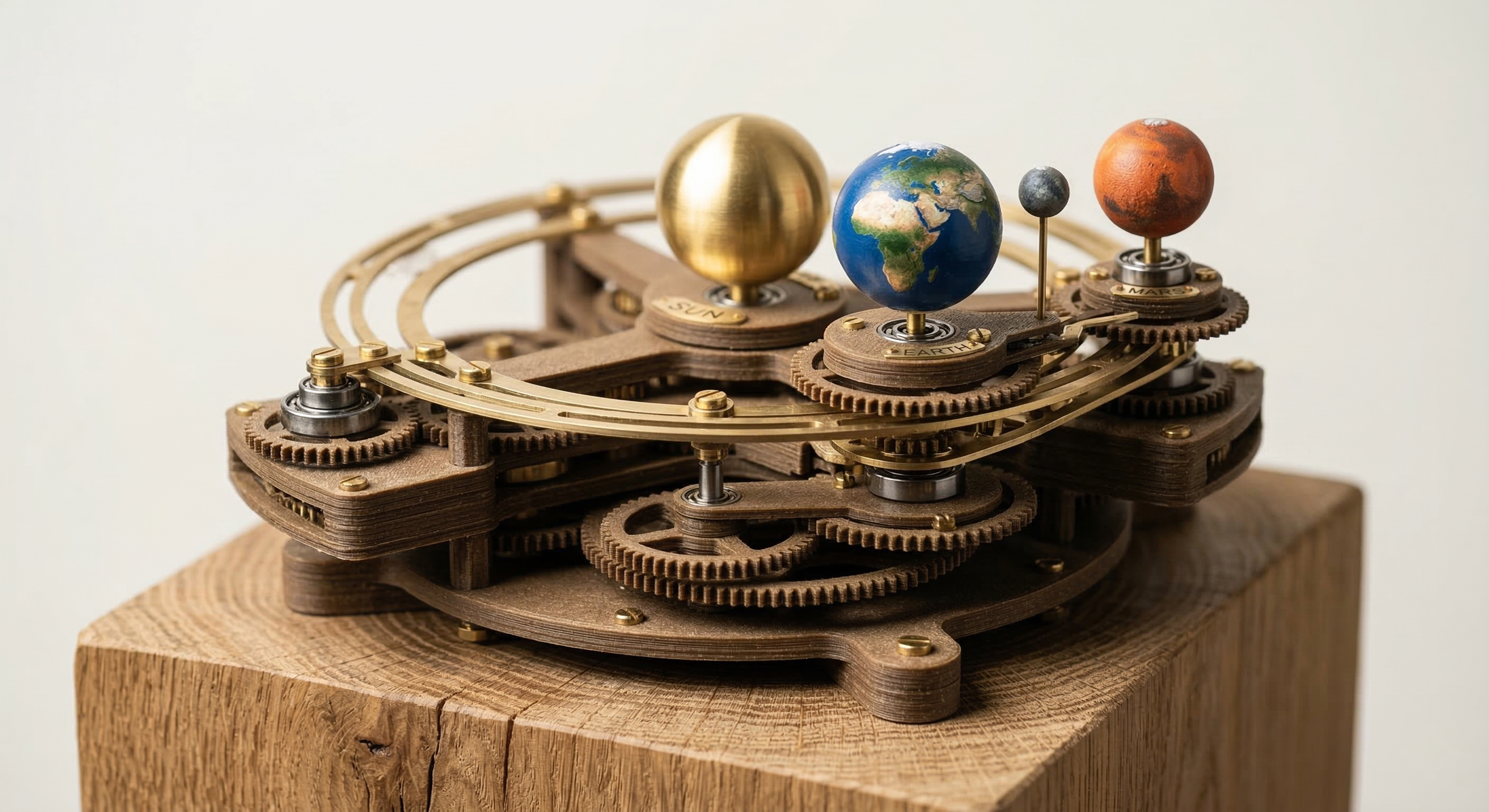
Astronomy,
The orrery, a hand-cranked solar system
Turn a crank and the Earth circles the Sun, the Moon circles the Earth. Three centuries of mechanical planetaria, from London to your desk.
Read the article (4 min)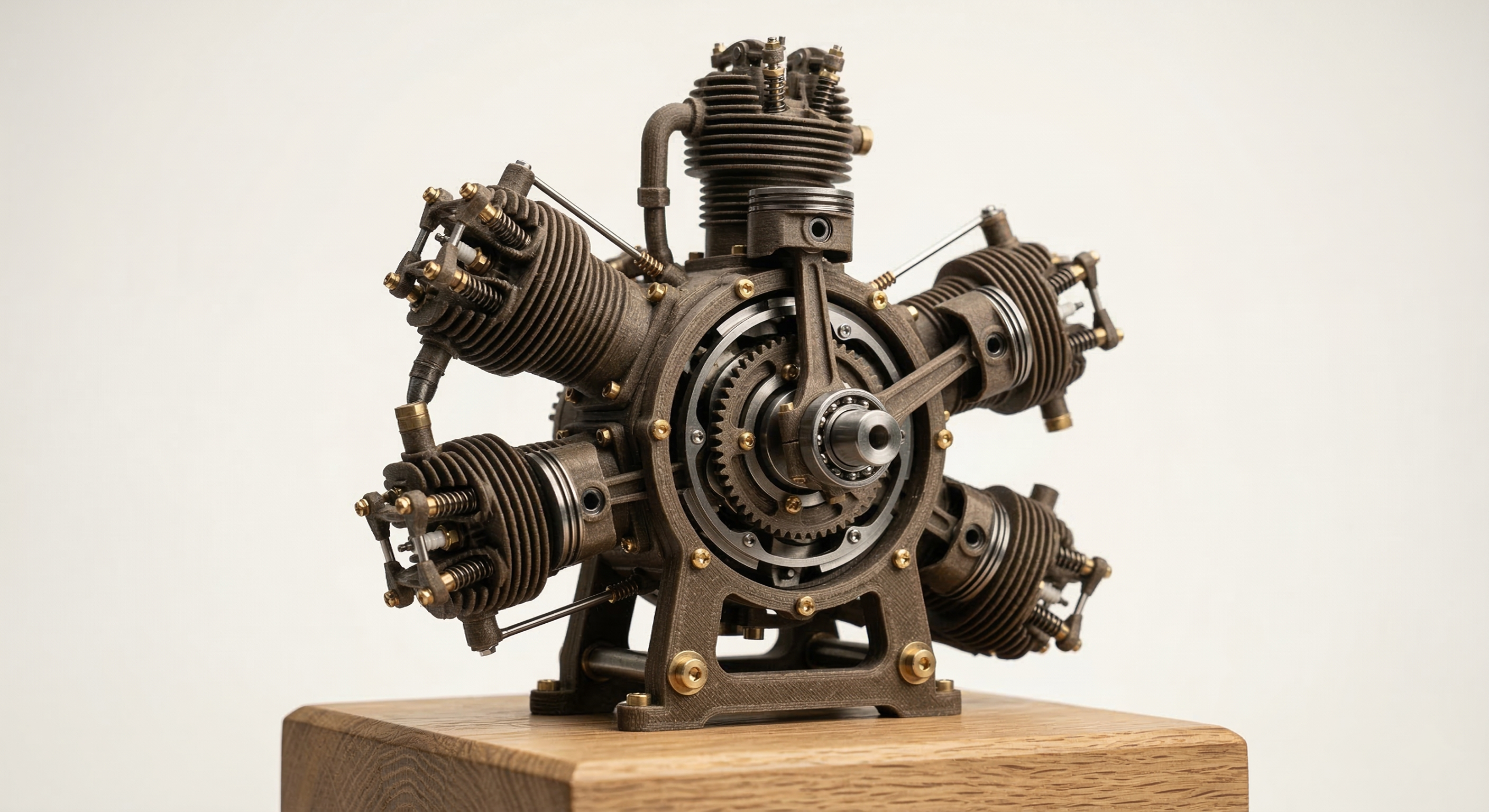
Thermodynamics,
The radial engine, cylinders in a star around a single crankshaft
Cylinders in a star, a master rod, an odd number of cylinders: the engine that crossed the Atlantic and carried the first airliners.
Read the article (5 min)